
Beyond the Numbers – The Hard Truth Behind Custom Eyewear Specifications
The frame looks good.
The lenses are thin.
The prescription matches their eyesight.
And that’s usually where the conversation ends.
But custom eyewear is not just about looks or basic prescription values. Behind every pair of truly well-made glasses lies a dense network of measurements, tolerances, optical principles, and design trade-offs—many of which never make it into marketing copy.
This article is about those hidden parameters.
Not the simplified versions you see on product pages, but the real technical factors that determine whether custom glasses feel effortless on your face—or quietly frustrate you every day.
If you’ve ever wondered why two pairs of glasses with “the same prescription” can feel completely different, this guide is for you.
Why Custom Eyewear Is More Than a Prescription
A prescription tells us what correction your eyes need.
It does not tell us:
- How the lenses sit in front of your eyes
- How light enters your pupils during daily movement
- How your face geometry interacts with frame structure
- How optical performance changes at the edges
- How comfort evolves over hours of wear
Custom eyewear exists because human faces and visual behavior are not standardized.
Mass-produced glasses assume averages.
Custom glasses account for reality.
And reality is messy, asymmetric, and highly individual.
The Myth of “Standard Fit”
Let’s start by debunking a common assumption.
There is no such thing as a truly “standard” fit.
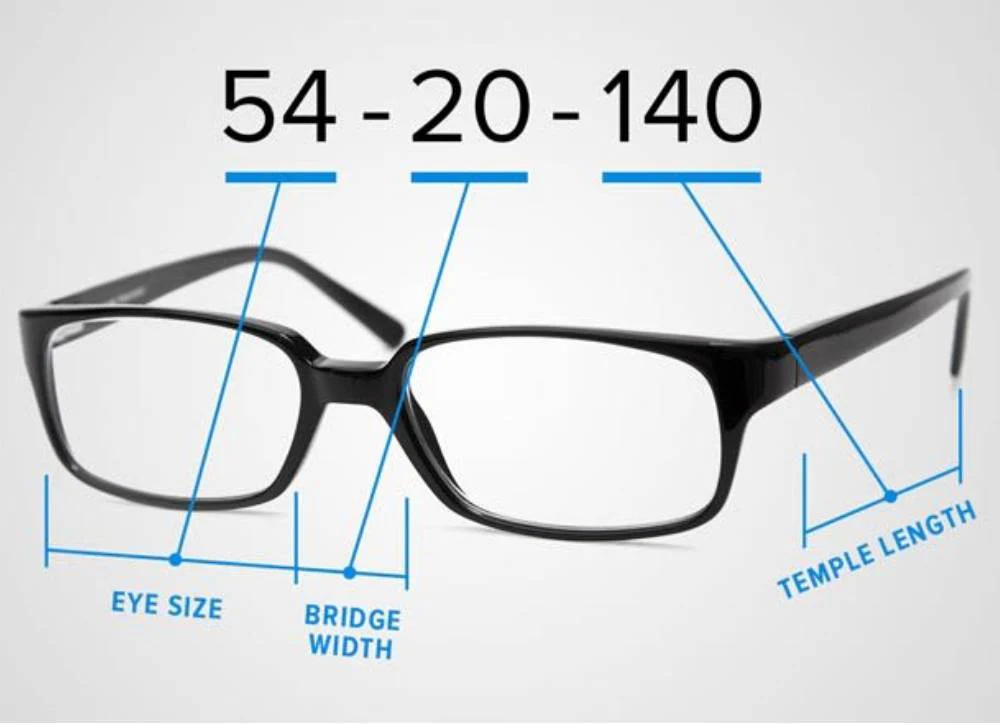
Two people with the same pupillary distance (PD) can experience completely different visual clarity if:
- Their nose bridge shapes differ
- Their frame wrap angles differ
- Their eye dominance differs
- Their posture and head tilt differ
Yet many glasses are still designed using flat assumptions:
- Symmetrical faces
- Static head position
- Ideal lens alignment
- Minimal eye movement
Custom eyewear begins where these assumptions break down.
Core Optical Parameters Most People Never Think About
1. Pupillary Distance (PD) Is Not Just One Number
Most consumers are familiar with PD as a single value:
“Your PD is 63 mm.”
In reality, PD has layers:
- Distance PD vs. Near PD
- Monocular PD (left and right measured separately)
- Functional PD under real wearing conditions
Why this matters:
Your eyes don’t sit perfectly centered in frames. Even a 1–2 mm deviation can introduce unwanted prismatic effects, eye strain, or subtle distortion—especially in higher prescriptions.
Custom eyewear treats PD as a dynamic alignment parameter, not a checkbox.
2. Optical Center Height: The Forgotten Variable
Vertical alignment matters just as much as horizontal alignment.
Optical center height determines where your eye looks through the lens most of the time, not just when your head is perfectly level.
Factors that affect this:
- Frame size and shape
- Nose pad height
- Lens vertical depth
- Natural head posture
Off-the-shelf glasses often center lenses based on frame geometry, not your eyes.
Custom lenses are centered on how you actually see, not how frames are drawn on paper.
3. Vertex Distance: The Space That Changes Everything
Vertex distance is the space between your eye and the lens surface.
Small difference. Big impact.
As vertex distance increases:
- Effective lens power changes
- Peripheral distortion increases
- Lens thickness perception shifts
This is especially critical for:
- High prescriptions
- Progressive lenses
- Wrap or sport frames
Custom eyewear accounts for your wearing distance—not a factory average.
Frame Geometry: Where Comfort and Optics Collide
Frames are not just fashion items.
They are structural optical components.
1. Pantoscopic Tilt
Pantoscopic tilt refers to the angle at which lenses tilt toward your cheeks.
Correct tilt:
- Improves optical alignment
- Reduces peripheral blur
- Enhances comfort during downward gaze (reading, screens)
Incorrect tilt:
- Causes distortion
- Increases eye fatigue
- Breaks progressive lens zones
Mass frames assume a default tilt.
Custom frames adjust it to your anatomy.
2. Face Wrap and Curvature
Modern frames often curve around the face for style and stability.
But increased wrap changes:
- Optical axis alignment
- Effective prescription power
- Peripheral aberrations
Custom eyewear compensates lens design for wrap angle.
Without compensation, even a “correct” prescription can feel wrong.
3. Bridge Design and Load Distribution
The bridge determines:
- Weight distribution
- Frame stability
- Pressure points on the nose
Two frames with the same width can feel completely different depending on:
- Bridge angle
- Saddle vs. keyhole design
- Pad material and adjustability
Custom eyewear considers comfort over hours, not just first impressions.
Lens Design: Where Most of the Magic Happens
1. Single Vision vs. Freeform Design
Traditional lenses are made using standard curves.
Freeform lenses are digitally surfaced point by point.
The difference:
- Freeform lenses optimize optical clarity across the entire lens
- They reduce peripheral distortion
- They adapt to frame shape and wearing parameters
Custom eyewear almost always relies on freeform technology—because customization without optical optimization is incomplete.
2. Progressive Lenses Are Personal by Nature
Progressive lenses are not “one size fits all.”
Variables include:
- Corridor length
- Zone width
- Transition softness
- Eye movement behavior
Two people with the same prescription may prefer completely different progressive designs.
Customization aligns lens behavior with how you actually use your vision:
- Reading habits
- Screen usage
- Driving patterns
- Occupational needs
3. Lens Material Choices Are Strategic
Index value affects:
- Thickness
- Weight
- Optical clarity
- Abbe value (chromatic aberration)
Higher index is not always better.
For some prescriptions:
- Mid-index offers better clarity
- Lower index offers better durability
- Thinner lenses may introduce more distortion
Custom eyewear balances material science—not just aesthetics.
Coatings: Not Just Add-Ons
Lens coatings are often treated as upsells.
In reality, they are functional layers that shape daily experience.
Key coatings include:
- Anti-reflective (reduces glare and halos)
- Hard coat (scratch resistance)
- Hydrophobic (easy cleaning)
- UV protection (long-term eye health)
- Blue light filtering (context-dependent)
Custom eyewear selects coatings based on usage, not trends.
Why Two “Identical” Glasses Feel Different
This question comes up constantly:
“Why do these glasses feel worse than my old pair, even with the same prescription?”
Because:
- PD was rounded
- Optical centers were frame-based
- Vertex distance changed
- Frame geometry altered alignment
- Lens design didn’t match usage
The parameters didn’t change on paper—but they changed in practice.
Custom eyewear exists to close that gap.
The Human Factor: Behavior Matters
Eyes are not static instruments.
They:
- Move constantly
- Adjust focus dynamically
- React to posture and environment
Custom eyewear considers:
- Screen-heavy lifestyles
- Multi-distance viewing
- Driving conditions
- Indoor vs. outdoor usage
Good glasses adapt to how you live, not just how you see.
Why Custom Eyewear Costs More—and Why That Matters
Customization adds cost because it adds:
- Measurement time
- Design complexity
- Manufacturing precision
- Quality control
- Iterative adjustment
You are not paying for materials alone.
You are paying for error reduction.
Mass eyewear tolerates averages.
Custom eyewear minimizes compromises.
Who Truly Benefits From Custom Eyewear?
Custom glasses are especially valuable for:
- High or asymmetric prescriptions
- Progressive lens users
- Long daily wearers
- Professionals with visual precision needs
- People who’ve “never felt comfortable” in glasses
For them, customization isn’t luxury—it’s functionality.
Final Thoughts: Numbers Are Only the Beginning
Eyewear specifications are not just numbers on a chart.
They are decisions about:
- Comfort
- Visual clarity
- Long-term eye health
- Daily quality of life
Custom eyewear takes those numbers seriously—then asks the harder questions behind them.
If you’ve ever felt that glasses were something you simply “put up with,” there’s a good chance the parameters weren’t wrong.
They were just incomplete.
And that’s where real customization begins.
Share this post







The Active Athlete’s Eyewear Survival Guide: How to Prevent Impact Damage and Sweat Wear
For athletes and fitness enthusiasts, eyewear isn’t just an accessory—it’s essential gear. Whether you’re sprinting under the sun, grinding through a high-intensity...
Can You Replace Lenses in Old Frames?
Over time, your vision may change, requiring a new prescription for corrective lenses. However, this doesn’t necessarily mean you need to replace...
The Zero-Gravity Vision: How Material Science Makes Custom Frames Lighter Than a Sheet of Paper
In the world of high-end optics, there is a "Sound Barrier" that designers have been trying to break for decades. It is...
Zero-Screw Design: Why Mechanical Snap-Fit Structures Are the Future of Custom Eyewear
Introduction: The Tiny Screw That Defined an IndustryFor more than a century, eyewear design has relied on one surprisingly fragile component: the...
The Zenith of Lightweight: The "Black Tech" Revolution in Customized Eyewear Materials
For the discerning eyewear wearer, the struggle has always been a trade-off between personality and pressure. We crave the bold, architectural lines...
Crafted to Perfection - The Art of Custom Glasses
Eyewear, once a deeply personal object, has quietly become disposable. Frames are mass-produced, faces are averaged, and individuality is trimmed down to...
A Must-Have for Drivers, How to Quickly Switch Polarized Lenses with One Hand While Driving
Modern driving demands more from our eyes than ever before. From harsh midday glare to sudden changes in lighting conditions, drivers constantly...
“One-Step” Investment: Why Custom Glasses Save You Money in the Long Run
When it comes to eyewear, many people focus on upfront cost rather than long-term value. It’s easy to fall into the trap...
Ultrasonic Cleaners: Savior or Silent Killer for Custom Eyewear? A Professional Guide to Safe Cleaning and Costly Mistakes
Custom eyewear has evolved far beyond simple vision correction. Today’s prescription glasses often feature precision-engineered lenses, specialized coatings, lightweight materials, and carefully...
Acetate vs Plastic Glasses Frames: Which is Better?
When selecting eyewear, understanding the differences between acetate and plastic frames can help you make the best choice for your needs. Both...
The Blueprint of the Future: If You Could Design a Modular "Combo" Frame, What Features Would You Demand?
We’ve all had that moment of frustration with our eyewear. You’re driving into a blinding sunset, and you realize your sunglasses are...
“Five O’Clock Headache”: Could Custom Eyewear Be the Cure for Your Daily Fatigue?
Around 4:30 p.m., your focus softens. By 5:00 p.m., there’s a dull pressure behind your eyes. Your temples tighten. The screen feels...