



Say Goodbye to the “Glasses Slip”: A Complete Ergonomic Guide to Custom Nose Pads for Low Nose Bridge Face Shapes
Eyeglasses are meant to improve vision, enhance comfort, and complement personal style — not constantly slide down your face. Yet for millions of people, especially those with low nose bridges, slipping glasses remain a daily frustration. Whether working at a computer, walking outdoors, or simply looking down at a phone, frames that refuse to stay in place can turn even premium eyewear into a source of annoyance.
The truth is simple: most eyewear is not originally engineered for low nose bridge facial anatomy. Standard frame geometry often assumes a higher nasal bridge and deeper nose-pad support area. When this assumption fails, comfort, stability, and optical performance suffer.
This article explores the science, engineering, and customization strategies behind ergonomic nose pad design for low nose bridge wearers. You’ll learn why glasses slip, how nose pad mechanics actually work, and how custom solutions can transform fit, comfort, and long-term eye health.
Understanding the Low Nose Bridge Anatomy
Before solving the slipping problem, we must understand the structure causing it.
A low nose bridge typically refers to a nasal profile where:
- The bridge sits closer to the face plane.
- The transition between forehead and nose is gradual rather than protruding.
- The nasal root provides less vertical support for frames.
- The cheekbones may sit higher relative to the bridge.
This facial geometry changes how eyewear distributes weight.
Key Biomechanical Differences
Traditional eyewear relies on three-point support:
- Nose bridge contact
- Left ear support
- Right ear support
For high-bridge faces, gravity naturally presses frames into a stable resting position. For low bridges, however:
- Contact area decreases.
- Friction reduces.
- Frames rotate forward.
- Weight shifts toward the front.
The result? Constant downward migration — commonly called the “glasses slip.”
Why Glasses Slide: The Physics Behind the Problem
Eyeglass slipping is not just a fit issue; it’s a mechanical imbalance involving gravity, friction, and torque.
1. Center of Gravity Misalignment
Every frame has a center of mass. When lenses sit farther away from the nose due to poor bridge contact, leverage increases.
This creates rotational torque that pulls glasses downward.
2. Reduced Friction Surface
Low bridges provide:
- Smaller contact area
- Less pressure distribution
- Increased skin movement
Without sufficient friction, even lightweight frames slide.
3. Incorrect Nose Pad Angle
Standard nose pads are angled for steeper nasal slopes. On flatter bridges, pads touch only partially, concentrating pressure into tiny points.
Less surface contact equals less stability.
4. Optical Consequences
Slipping glasses don’t just feel uncomfortable — they affect vision:
- Optical centers shift below pupil alignment.
- Progressive lenses lose accuracy.
- Digital eye strain increases.
- Head posture compensates unconsciously.
Over time, this can cause neck tension and fatigue.
The Evolution of Nose Pad Engineering
Historically, eyewear design prioritized aesthetics and mass manufacturing efficiency rather than anatomical diversity.
Early Designs
Early metal frames used fixed pads with limited adjustability. Plastic frames later introduced molded bridges, which worsened fit issues for low-bridge users.
Modern Ergonomic Shift
Today’s engineering focuses on:
- Anthropometric facial data
- Pressure mapping
- Adjustable geometry
- Custom fabrication
Nose pads have evolved into micro-engineered components rather than simple supports.
The Ergonomics of Nose Pads: Core Design Principles
To stop glasses from sliding, nose pads must achieve four ergonomic goals.
1. Maximum Contact Area
A larger contact surface distributes weight evenly and increases friction.
Custom pads contour to nasal curvature rather than pressing at single points.
2. Correct Pad Angle
The pad should sit flush against skin, not edge-first.
Ideal angle varies by face structure but typically requires:
- Increased inward rotation
- Reduced vertical tilt
3. Pressure Distribution
Even pressure prevents pain and improves grip.
Too much pressure causes redness; too little causes instability.
4. Material Friction Coefficient
Materials dramatically affect performance.
Common options include:
- Silicone (high grip)
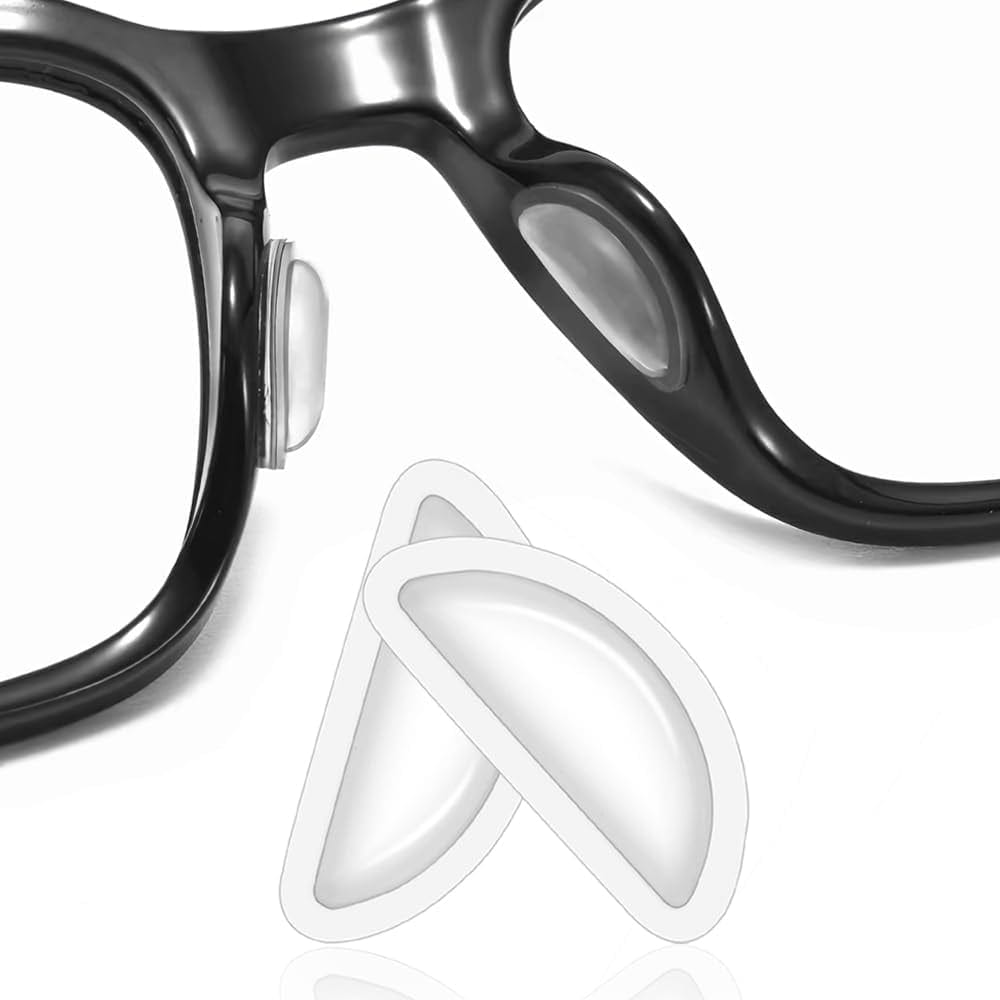
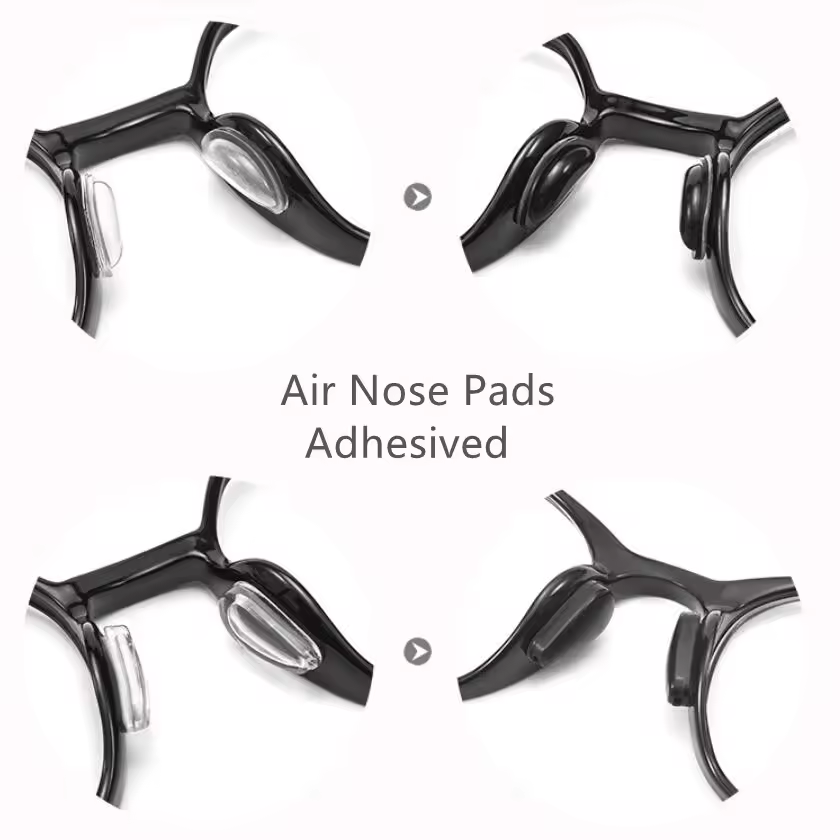
- Air-cushion pads
- Medical-grade TPU
- Titanium-core hybrid pads
Custom Nose Pad Engineering for Low Nose Bridges
Customization transforms eyewear from generic accessory into wearable engineering.
Step 1: Facial Mapping
Modern fitting begins with analyzing:
- Bridge width
- Nasal slope angle
- Skin compression response
- Frame weight distribution
Advanced optical shops may use digital face scanning to capture precise geometry.
Step 2: Pad Shape Selection
Low bridges benefit from:
- Larger oval pads
- Teardrop designs
- Extended saddle supports
These shapes increase stabilization zones.
Step 3: Adjustable Arm Geometry
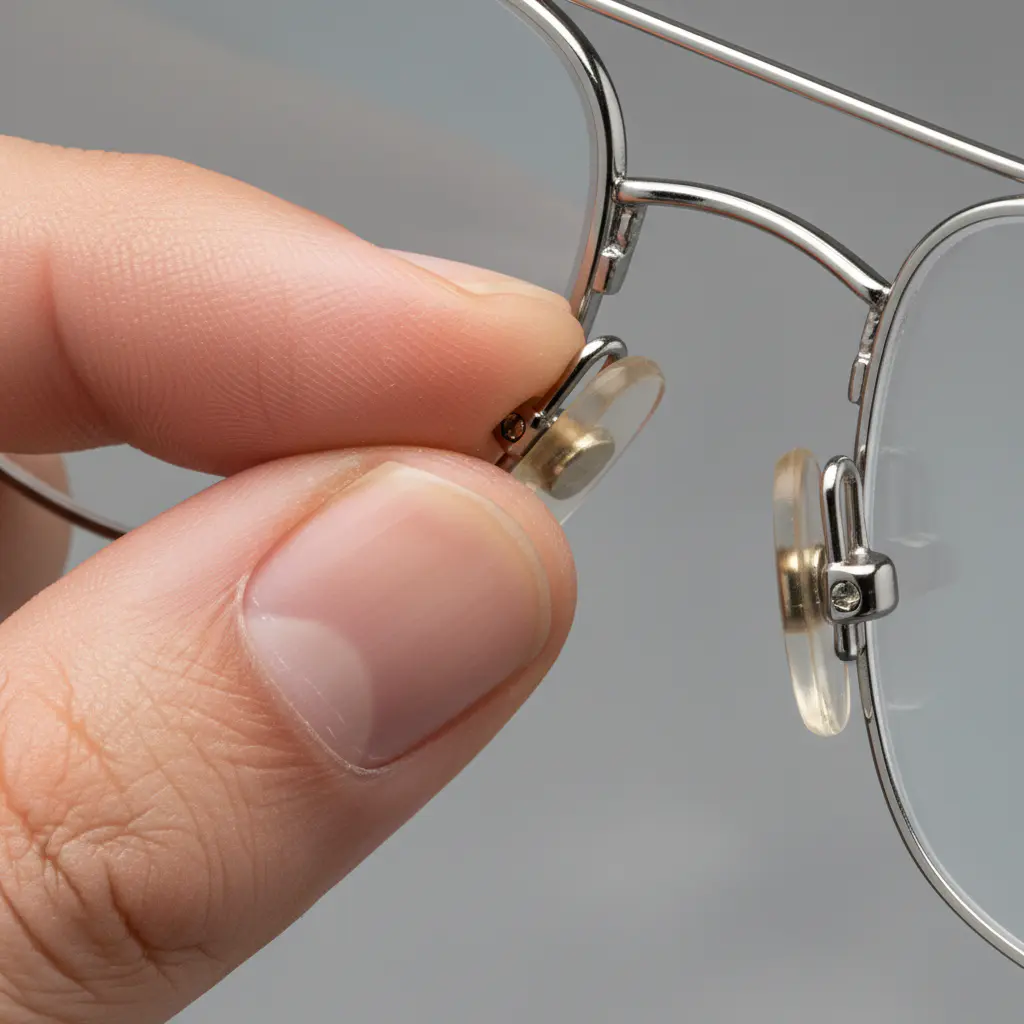
The tiny metal arms holding nose pads — called pad arms — are critical.
Engineers adjust:
- Spread angle
- Forward projection
- Vertical height
- Symmetry alignment
Millimeter-level changes dramatically affect comfort.
Step 4: Material Optimization
For low bridges, higher-friction materials outperform rigid plastics.
Silicone pads often provide the best balance between grip and comfort, especially for long digital work sessions.
Asian-Fit vs Universal-Fit Frames: What’s the Difference?
The eyewear industry increasingly recognizes anatomical diversity through specialized designs often labeled:
- Low-bridge fit
- Asian fit
- Alternative fit
These frames incorporate structural differences:
- Higher nose pad placement
- Reduced frame curvature
- Shorter vertex distance
- Modified bridge width
However, labeling alone is not enough — customization still matters.
The Hidden Role of Lens Weight
Many wearers overlook lens weight as a slipping factor.
Heavier lenses increase downward force.
High-Risk Lens Types
- High prescriptions
- Glass lenses
- Thick progressive designs
- Blue-light multilayer coatings
Engineering Solutions
- High-index materials
- Aspheric lens design
- Edge thinning
- Balanced frame selection
Reducing front weight significantly improves stability.
Skin Interaction: Friction, Oil, and Micro-Movement
Human skin changes throughout the day.
Factors affecting grip include:
- Sweat
- Skin oil production
- Temperature
- Makeup or sunscreen
Custom pads compensate by increasing surface conformity rather than relying solely on friction.
Textured silicone surfaces can maintain stability even under humid conditions.
Adjustable vs Fixed Nose Pads
Fixed Bridges
Pros:
- Cleaner aesthetics
- Lightweight construction
Cons:
- Limited adaptability
- Poor compatibility with low bridges
Adjustable Pads
Pros:
- Precision fitting
- Long-term adaptability
- Personalized comfort
For low nose bridge wearers, adjustable pads are usually the superior choice.
Professional Fitting: What Actually Happens
A skilled optician performs micro-adjustments often invisible to the wearer.
Typical process includes:
- Frame leveling
- Nose pad spreading
- Pad rotation adjustment
- Temple alignment
- Weight redistribution testing
The goal is balanced contact — glasses should feel stable without pressure.
DIY Adjustments: What You Can Safely Do
Some minor improvements can be done at home.
Safe Adjustments
- Cleaning pads to restore friction
- Tightening loose screws
- Using temporary silicone sleeves
Avoid
- Bending metal without tools
- Heating acetate frames excessively
- Over-widening pads
Improper adjustments can permanently damage frames.
Long-Term Comfort and Health Benefits
Proper nose pad ergonomics provide more than convenience.
Benefits Include
- Stable optical alignment
- Reduced headaches
- Improved posture
- Less skin irritation
- Better visual clarity
Comfort directly influences how consistently people wear corrective lenses.
Emerging Technologies in Nose Pad Design
Eyewear innovation continues to advance rapidly.
3D-Printed Custom Pads
Using facial scans, manufacturers can produce pads tailored to individual anatomy.
Smart Pressure Mapping
Sensors measure real-time pressure distribution during fitting.
Adaptive Materials
Memory polymers adjust shape slightly with body heat for improved conformity.
These technologies signal a future where slipping glasses may become obsolete.
Choosing the Right Frame for Low Nose Bridges
When shopping, prioritize structure over appearance alone.
Look for:
- Adjustable nose pads
- Narrow bridge measurements
- Lightweight materials
- Balanced lens height
- Proper temple curvature
Trying frames while moving, looking down, and smiling helps reveal stability issues early.
Common Myths About Sliding Glasses
Myth 1: Tight Frames Fix Everything
Over-tightening causes discomfort without solving balance issues.
Myth 2: Only Cheap Glasses Slip
Even luxury frames fail without ergonomic alignment.
Myth 3: Nose Pads Are Minor Details
In reality, they are the primary stabilization system.
Maintenance Tips for Long-Term Stability
Proper care preserves ergonomic performance.
- Clean pads weekly with mild soap.
- Replace worn silicone every 6–12 months.
- Schedule professional adjustments annually.
- Avoid leaving glasses in hot cars.
Small maintenance habits prevent recurring slipping.
The Psychological Impact of Well-Fitting Glasses
Comfort influences confidence more than many realize.
When glasses stay in place:
- Eye contact improves.
- Facial expressions feel natural.
- Self-conscious adjustments disappear.
- Productivity increases.
Ergonomic design quietly enhances daily life.
Future Trends: Personalized Eyewear Engineering
The industry is moving toward personalization as the standard rather than the exception.
Expect to see:
- AI-assisted fitting systems
- Modular nose pad ecosystems
- Custom-fit subscription eyewear
- Biometric comfort analytics
Eyeglasses are evolving from fashion accessories into precision wearable devices.
Final Thoughts: Engineering Comfort, Not Fighting Gravity
Glasses slipping down the nose is not a personal flaw — it’s an engineering mismatch. Low nose bridge facial structures simply require different support mechanics than traditional frame designs provide.
By understanding anatomy, physics, and ergonomic customization, wearers can finally eliminate the daily frustration of constant adjustments.
Custom nose pad engineering represents a small component with enormous impact. When properly designed and fitted, it restores balance between frame and face, allowing glasses to perform their true purpose: delivering clear vision effortlessly.
The solution isn’t tighter frames or constant pushing — it’s smarter design grounded in human anatomy.
Say goodbye to the glasses slip, and experience eyewear that works with your face instead of against it.

Leave a Reply
You must be logged in to post a comment.