
Digital Face Scanning: Marketing Hype or the Future of Millimeter-Level Eyewear Fit?
Walk into a modern optical store or browse premium eyewear brands online today, and you’ll likely encounter a bold promise: digital face scanning. Brands claim it delivers unprecedented accuracy, personalized comfort, and frames tailored down to the millimeter. Some even suggest it will replace traditional fittings entirely.
But is digital facial scanning truly a breakthrough in eyewear customization, or is it simply another technology-driven marketing narrative designed to attract attention?
The answer lies somewhere in between — and understanding where requires exploring the technology, the science of fit, the limits of human measurement, and the evolving expectations of consumers who want glasses that feel invisible on their faces.
This article takes a deep, practical look at digital face scanning: how it works, why precision matters, where it succeeds, where it still falls short, and whether it represents the future of eyewear design or just an impressive sales tool.
Why Eyewear Fit Has Always Been a Challenge
Eyeglasses sit at the intersection of fashion, engineering, and human anatomy. Unlike clothing, eyewear depends on extremely small tolerances.
A difference of just 1–2 millimeters can affect:
- Optical alignment
- Pressure distribution
- Long-term comfort
- Lens performance
- Visual clarity
Traditional fitting methods rely on manual measurements performed by opticians using rulers or pupilometers. These techniques have worked for decades, but they depend heavily on human skill and consistency.
Common manual measurements include:
- Pupillary distance (PD)
- Bridge width
- Temple length
- Pantoscopic tilt
- Vertex distance
While experienced professionals achieve excellent results, manual measurement introduces variability. Two opticians may produce slightly different results for the same person.
Digital face scanning aims to remove that variability.
What Is Digital Face Scanning?
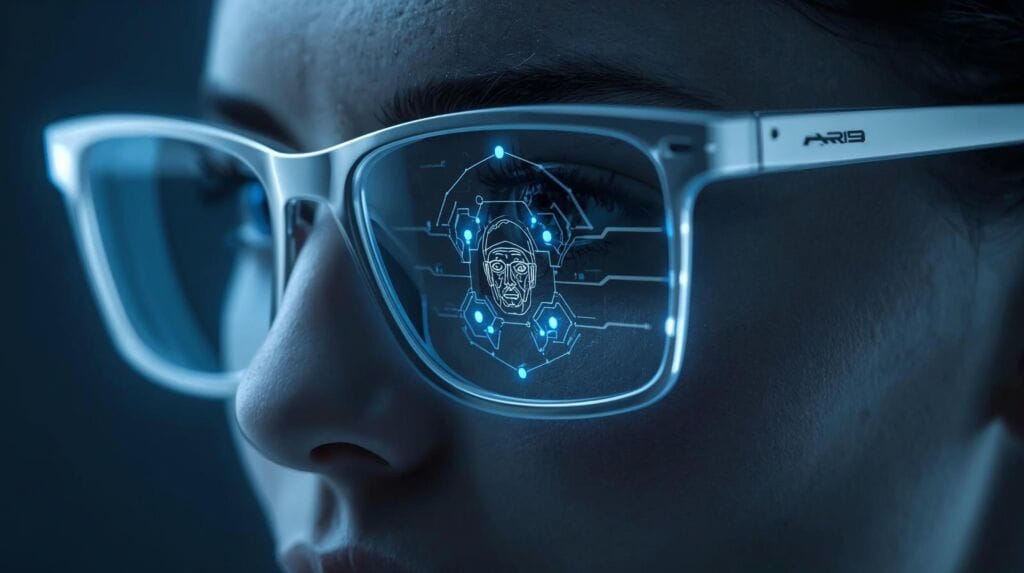
Digital face scanning uses cameras, sensors, and software algorithms to create a detailed three-dimensional model of a person’s face.
Instead of measuring a few reference points, scanning captures thousands — sometimes millions — of data points.
The process typically involves:
- Multiple images or depth scans taken from different angles
- AI-driven reconstruction of facial geometry
- Automatic detection of anatomical landmarks
- Generation of measurement data used for frame design or lens positioning
The result is a digital replica of the wearer’s facial structure.
This model can then guide frame customization or lens optimization.
How the Technology Actually Works
Not all scanning systems are equal. There are several underlying technologies.
1. Structured Light Scanning
A pattern of light is projected onto the face. Cameras analyze how the pattern distorts across contours to calculate depth.
Advantages:
- High precision
- Fast capture
- Reliable indoors
Limitations:
- Sensitive to strong sunlight
- Requires controlled lighting
2. Photogrammetry
Multiple photographs are combined to reconstruct a 3D surface.
Advantages:
- Works with standard cameras
- Accessible through smartphones
Limitations:
- Accuracy depends on image quality
- Movement can reduce precision
3. Infrared Depth Sensors
Similar to facial recognition systems in modern smartphones.
Advantages:
- Quick scanning
- User-friendly
- Works in low light
Limitations:
- Lower resolution than professional scanners
4. LiDAR-Based Scanning
Advanced depth sensing technology mapping distance using laser pulses.
Advantages:
- Highly detailed geometry
- Excellent spatial accuracy
Limitations:
- Higher cost
- Still emerging in eyewear retail
Why Millimeter-Level Accuracy Matters
Eyewear is unique because lenses interact directly with human vision.
Even minor misalignment can cause:
- Eye strain
- Peripheral distortion
- Reduced progressive lens performance
- Headaches
- Poor adaptation
Digital scanning helps calculate critical parameters more precisely:
Pupillary Distance (PD)
Traditional measurement captures a single distance. Scanning captures dynamic eye positioning relative to frame shape.
Optical Center Alignment
Scanning allows lenses to align with how frames actually sit on the face — not how they sit on a flat table.
Frame Wrap and Tilt
These angles significantly affect modern lens designs, especially high-index or progressive lenses.
Millimeter-level precision improves visual comfort, not just aesthetics.
The Psychology of Comfort: Why Fit Feels Different
Comfort is not purely mechanical.
Humans perceive pressure asymmetrically. Slight imbalance across the nose or ears becomes noticeable after hours of wear.
Digital scanning identifies:
- Facial asymmetry
- Nose bridge slope
- Ear height differences
- Cheekbone positioning
Nearly every face has asymmetry — often invisible until measured digitally.
Traditional frames assume symmetry. Digital design adapts to reality.
Where Digital Face Scanning Truly Excels
Custom 3D-Printed Frames
Scanning pairs naturally with additive manufacturing.
Designers can adjust:
- Bridge curvature
- Temple angles
- Frame width gradients
- Weight distribution
Instead of choosing from sizes (S, M, L), frames become individually generated products.
Progressive and High-Performance Lenses
Advanced lenses benefit significantly from precise fitting data.
Scanning enables:
- Personalized lens corridors
- Reduced distortion zones
- Faster adaptation periods
Many wearers report clearer peripheral vision when lenses are digitally optimized.
Remote Eyewear Purchasing
Online eyewear shopping historically struggled with fit uncertainty.
Digital scanning allows at-home measurement through smartphone apps, reducing guesswork.
This has major implications for direct-to-consumer eyewear brands.
Is It Just Marketing Hype?
The honest answer: sometimes yes — but often no.
Some brands use scanning primarily as a visual demonstration rather than a precision tool.
Signs scanning may be more marketing than function:
- Results don’t change frame design
- Measurements aren’t shared or explained
- Frames remain standard sizes
- No customization occurs afterward
In these cases, scanning enhances customer experience but not product performance.
True implementation integrates scanning data directly into manufacturing.
Accuracy: How Precise Is Digital Scanning Really?
Professional optical scanners can achieve accuracy within ±0.5 mm under ideal conditions.
Smartphone-based systems typically achieve:
- ±1–2 mm accuracy
For many applications, this is still comparable to manual measurements.
However, accuracy depends on:
- Lighting conditions
- User movement
- Camera quality
- Software calibration
Technology alone doesn’t guarantee precision — execution matters.
The Role of Artificial Intelligence
AI plays a critical role in modern scanning systems.
Algorithms identify landmarks such as:
- Pupils
- Nose contours
- Ear attachment points
- Facial symmetry axes
Machine learning improves accuracy over time by analyzing large datasets.
AI also predicts optimal frame positioning rather than relying solely on static measurements.
Privacy Concerns: The Hidden Conversation
Digital face scans create biometric data — one of the most sensitive data categories.
Consumers should ask:
- Is facial data stored or deleted?
- Is data encrypted?
- Can scans be reused?
- Is consent required?
Responsible brands prioritize transparency and user control.
Trust will shape adoption as much as technology itself.
Limitations of Digital Face Scanning
Despite its promise, scanning is not perfect.
Facial Expression Variability
Smiling, blinking, or slight head movement changes measurements.
Hair and Accessories
Hairlines or hats may interfere with scans.
Dynamic Fit Factors
Scanning captures static geometry but not movement during daily wear.
Comfort also depends on:
- Material flexibility
- Weight balance
- Surface finish
Technology cannot replace ergonomic design expertise.
The Optician’s Role Isn’t Disappearing
Contrary to popular belief, scanning enhances professional expertise rather than replacing it.
Opticians still evaluate:
- Lifestyle needs
- Prescription complexity
- Frame suitability
- Adjustment after delivery
Technology provides data; professionals interpret it.
The future combines human judgment with digital precision.
Comparing Traditional vs Digital Fitting
| Feature | Traditional Measurement | Digital Face Scanning |
|---|---|---|
| Speed | Moderate | Fast |
| Precision | Skill-dependent | Consistent |
| Data Depth | Limited points | Full facial map |
| Customization | Limited | Extensive |
| Repeatability | Variable | High |
Each approach has strengths, but digital methods expand possibilities.
Consumer Expectations Are Changing
Modern consumers increasingly expect personalization everywhere:
- Custom sneakers
- Tailored skincare
- Personalized nutrition
- Made-to-measure furniture
Eyewear is naturally moving in the same direction.
Digital scanning aligns with broader cultural shifts toward individualization.
The Economics Behind the Technology
Scanning systems require investment:
- Hardware costs
- Software licensing
- Training
- Integration with manufacturing
As adoption increases, costs decline, making the technology accessible beyond luxury markets.
Eventually, scanning may become standard practice rather than a premium feature.
Real-World Benefits Users Notice
Wearers commonly report:
- Reduced slipping
- Better weight balance
- Less nose pressure
- Improved visual stability
- Faster adaptation to new lenses
These improvements often feel subtle individually but significant collectively.
Future Innovations Already Emerging
The next generation of digital fitting may include:
- Dynamic scanning during movement
- AI-driven frame recommendations
- Real-time virtual try-ons with physics simulation
- Predictive comfort modeling
- Integration with augmented reality devices
Eyewear may evolve from static objects into digitally engineered wearables.
When Digital Face Scanning Makes the Most Sense
You benefit most if you:
- Wear progressive lenses
- Have high prescriptions
- Struggle with frame comfort
- Experience frequent adjustments
- Want custom or 3D-printed frames
For simple single-vision prescriptions, benefits may be less dramatic but still meaningful.
The Environmental Impact Angle
Precise fitting reduces product returns and remakes.
Fewer remakes mean:
- Less material waste
- Lower shipping emissions
- More efficient manufacturing
Precision indirectly supports sustainability.
So… Marketing Hype or the Future?
Digital face scanning began as a differentiator — a way for brands to stand out.
But as technology matures, it increasingly delivers measurable functional benefits.
The truth is:
- Early implementations leaned toward marketing appeal.
- Modern systems increasingly enable real customization.
- Future iterations will likely redefine eyewear fitting standards.
Like many technologies, it transitioned from novelty to necessity.
Final Thoughts
Digital face scanning represents more than a flashy retail experience. At its best, it bridges the gap between human anatomy and product engineering, allowing eyewear to adapt to individuals rather than forcing individuals to adapt to standardized frames.
Millimeter-level precision may sound excessive — until you remember that vision itself depends on microscopic alignment.
The technology is not magic, and it does not eliminate the need for skilled professionals or thoughtful design. But when properly implemented, digital scanning transforms eyewear from a fitted accessory into a personalized optical device.
The future of eyewear isn’t simply about better-looking frames. It’s about smarter fit, deeper personalization, and products shaped around real human geometry.
Digital face scanning isn’t just a marketing story anymore.
It’s becoming the foundation of how glasses will be designed, manufactured, and experienced in the years ahead.
Share this post
The Romance of Earth Tones in Fall: The Color Aesthetics of Trench Coats, Saddle Bags, and Tea-Tinted Sunglasses
Introduction: Falling in Love With the Colors of AutumnThere is something irresistibly romantic about autumn fashion.As summer fades, bright colors gradually give...
Best Glasses for Your Face Shape: Round, Square, Oval & More
Introduction: The Right Glasses Can Transform Your Entire AppearanceChoosing a pair of glasses is about much more than simply correcting your vision....
From Head to Toe: The Golden Ratio for Styling Glasses, Clothing, and Bags
Introduction: The Secret to Looking Polished From Head to ToeGreat style is rarely about wearing the most expensive clothes, following every trend,...

Minimalist Style: How Glasses and Bags Add the Perfect Finishing Touch to Black, White, and Gray Outfits
Minimalist fashion is often described as simple, effortless, and timeless. But creating a truly polished minimalist outfit is not as easy as...

Effortless Style: The Perfect Chemistry of Oversized Sweatshirts, Crossbody Bags, and Vintage Metal-Frame Glasses
Introduction: Why Relaxed Style Feels So RightFashion does not always have to look carefully calculated.Sometimes, the most appealing outfit is the one...

The Symphony of Metallic Elements: The Art of Layering Belt Buckles, Chain Bags, and Metal Frames
Introduction: When Metal Becomes a Fashion LanguageFashion has always been a conversation between materials, shapes, and personal expression. Among all design elements,...

Eyeglasses as the Finishing Touch: How to Make Your Frames Blend Perfectly Into Your Everyday Outfits
Eyeglasses are more than a tool for clearer vision. Today, they are one of the most powerful accessories in a modern wardrobe....

Old Money Style Guide: How Cashmere Coats, Premium Leather Bags, and Classic Black Frame Glasses Create Timeless Elegance
Introduction: Understanding the True Meaning of Old Money FashionFashion trends come and go, but true elegance has always been about something deeper...

The Ultimate Style Rescue for Round-Faced Women: How Necklines, Bag Placement, and Geometric Glasses Create a Slimmer Look
Introduction: Redefining Beauty Beyond Face ShapeFor many women with round faces, getting dressed can sometimes feel like a constant battle. The cheeks...

One Swipe, Crystal Clear: The Ultimate Guide to Efficient Eyeglass Cleaning
Introduction: Clear Vision Starts With Proper Lens CareFor millions of people around the world, eyeglasses are an essential part of daily life....

Eyeglasses as the Finishing Touch to Your Outfit: How Frame Shapes Can Elevate Your Style
Introduction: Eyeglasses as the Ultimate Fashion AccessoryWhen people think about fashion accessories, they often consider watches, jewelry, handbags, shoes, or clothing details....
Blue Light Protection or UV Protection? Common Mistakes When Choosing Eye Protection Glasses
Introduction: Choosing the Right Eye Protection Is More Complicated Than It LooksEyeglasses have evolved far beyond simple vision correction tools. Today, consumers...