
What Are Interchangeable Glasses? A Complete Guide to Base Frames, Toppers & How They Work
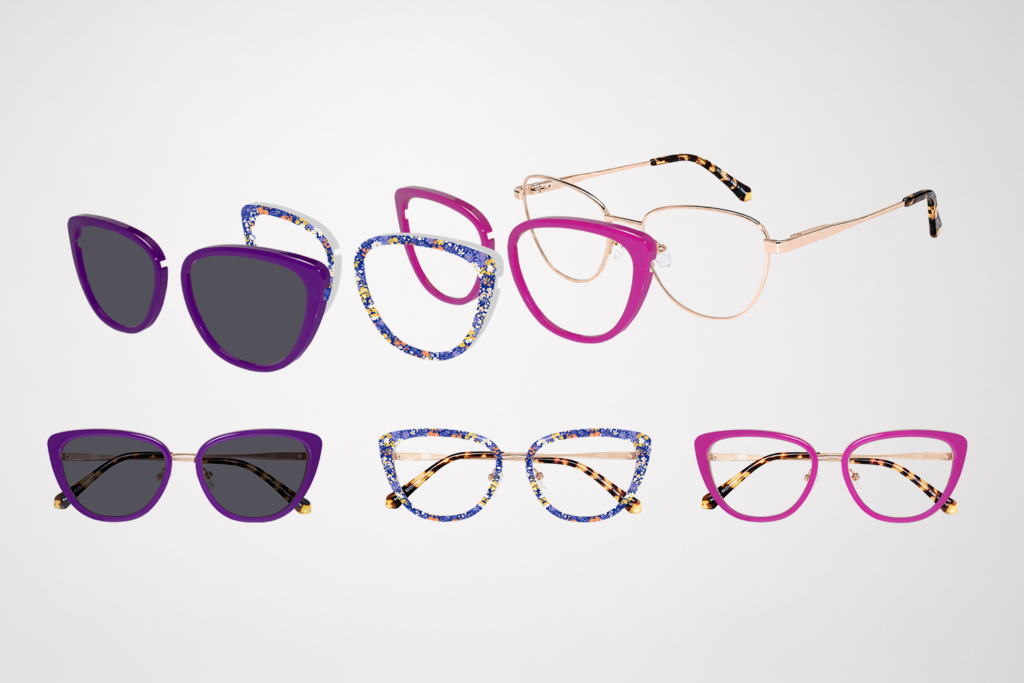
Interchangeable glasses are modular eyewear systems that let you change the visible style or function of your glasses without replacing your main base frame and prescription lenses. Instead of buying a completely new pair every time you want a different color, pattern, design, or sunwear option, you keep one compatible base frame and attach removable glasses toppers, also called eyewear toppers or top frames.
Different interchangeable eyewear systems use different attachment methods. Some use magnets, while others use mechanical connections such as snap-fit designs.
The result is a more flexible approach to eyewear: one base frame can support your vision needs while multiple toppers change the way your glasses look—and, in some systems, what they can do.
How Do Interchangeable Glasses Work?
Most interchangeable glasses are built around two main components:
1. The Base Frame
The base frame is the primary pair of glasses you actually wear.
It typically includes:
- Prescription or non-prescription lenses
- The temples and hinges
- Nose pads or bridge
- The main structural components of the glasses
In an interchangeable eyewear system, the base frame stays in place while compatible toppers can be added or removed to change the appearance or function of the eyewear.
For prescription wearers, this is especially useful because the vision-correcting lenses remain installed in the base frame.
You do not need a separate pair of prescription lenses every time you want a different style.
2. The Glasses Topper
A glasses topper is a removable outer frame designed to fit over or integrate with a compatible base frame.
You may also see toppers described as:
- Eyewear toppers
- Eyeglass toppers
- Top frames
- Interchangeable top frames
- Interchangeable eyewear toppers
Depending on the system, toppers can come in different colors, patterns, finishes, materials, and designs.
Most decorative glasses toppers do not contain prescription lenses. Your prescription remains in the base frame.
However, some toppers can be fitted with polarized sun lenses. When a polarized sun topper is attached to a base frame that already contains prescription lenses, the combination can transform your everyday prescription glasses into sunglasses without requiring a separate pair of prescription sunglasses.
This creates two different ways toppers can change your eyewear:
Style toppers change the visual appearance of the frame.
Sun toppers can add sun protection and transform the function of the eyewear while your prescription remains in the base frame.
That means the same base frame could look understated for work, colorful for a weekend outfit, or become a pair of prescription sunglasses simply by changing the compatible topper.
Why Do People Choose Interchangeable Glasses?
Traditional glasses usually combine the frame, style, function, and prescription lenses into one complete product.
If you want a different look—or a separate pair of prescription sunglasses—you may need to purchase another complete pair of eyewear.
Interchangeable eyewear separates some of those functions.
The base frame provides the vision correction and structural foundation, while toppers can provide much of the visible styling and, in certain designs, additional sun protection.
This creates several practical advantages.
More Style Options From One Base Frame
Instead of choosing one frame color for everyday wear, you can switch toppers to match different outfits, occasions, seasons, or moods.
A neutral topper might work for the office, while a brighter color or patterned design can create a noticeably different look later in the day.
You Keep the Same Prescription Lenses
For compatible prescription systems, your prescription remains in the base frame.
Changing a topper does not normally require changing the prescription lenses themselves.
This can make interchangeable eyewear particularly appealing to people who enjoy having multiple frame styles but do not want to purchase a separate set of prescription lenses for every look.
Prescription Glasses Can Become Sunglasses
Some interchangeable eyewear systems offer toppers fitted with polarized sun lenses.
When one of these sun toppers is attached over a prescription base frame, the prescription lenses continue to provide vision correction while the topper adds sunglass functionality.
Instead of switching between regular prescription glasses and a completely separate pair of prescription sunglasses, you may be able to convert the same base frame for outdoor use.
Less Space Than Multiple Complete Pairs
Toppers are generally flatter and more compact than complete pairs of glasses.
For people who enjoy changing their eyewear frequently, a base frame plus a collection of toppers can be easier to organize, store, and travel with.
Easier Style Experimentation
Eyewear is one of the most visible accessories people wear.
Interchangeable glasses make it easier to experiment with different colors, patterns, materials, and designs without committing to an entirely new pair of prescription glasses every time.
What Is the Difference Between Interchangeable Glasses and Regular Glasses?
The biggest difference is modularity.
With regular glasses, the visible frame and prescription lenses are usually part of one fixed pair.
With interchangeable glasses, the system is designed so that part of the visible frame—and sometimes its sunwear function—can be changed independently.
| Regular Glasses | Interchangeable Glasses |
|---|---|
| One fixed frame design | One base frame with multiple topper options |
| A new look usually requires another complete pair | A new look can often be created by changing the topper |
| Prescription lenses are tied to each complete pair | Prescription lenses remain in the base frame |
| Separate prescription sunglasses may be needed | Some systems can use polarized sun toppers |
| Style and vision correction are combined | Vision correction, styling, and certain functions can be more modular |
Interchangeable glasses are not intended to replace every type of eyewear. They simply offer another way to think about frame ownership—especially for people who enjoy changing their style or want greater flexibility from one prescription base frame.
How Do Glasses Toppers Attach?
There is no single attachment system used by every interchangeable eyewear brand.
Two important approaches are magnetic attachment and mechanical snap-fit attachment.
Magnetic Glasses Toppers
Magnetic systems use magnets positioned within the base frame and compatible top frame.
The magnets align the topper and hold it against the base glasses.
The main appeal of magnetic systems is convenience. A topper can usually be attached or removed very quickly.
Pair Eyewear is one well-known example of an interchangeable eyewear system that uses magnetic Top Frames.
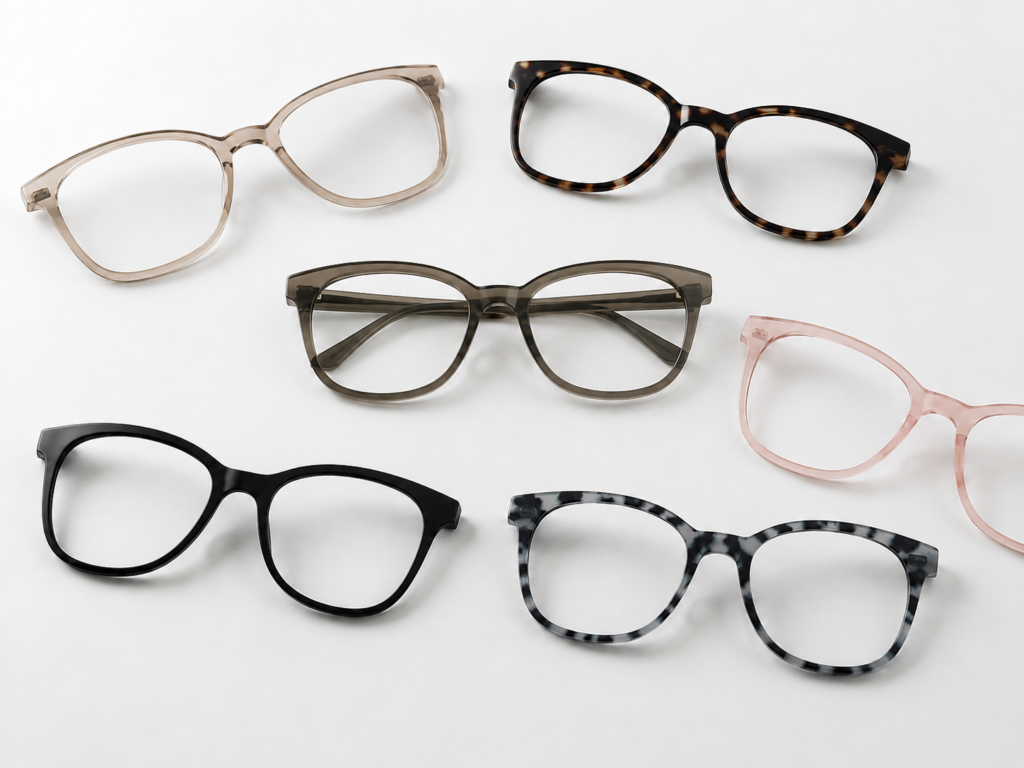
Snap-Fit Glasses Toppers
Snap-fit systems rely on mechanical engagement rather than magnetic attraction.
In a typical snap-fit design, the topper may incorporate precisely positioned grooves, notches, retaining features, or stops. These features are designed to engage with structural areas of the base frame, such as the rim wire, endpieces, bridge, or other designated contact points.
When the topper is correctly aligned with the compatible base frame, these features fit closely around or engage with the frame structure, allowing the two components to connect securely.
This type of construction can create a high degree of physical integration between the topper and the base frame. Rather than simply placing one frame in front of another, the topper can be designed to follow and engage with the geometry of the base frame itself.
XCombo uses a snap-fit topper connection.
Its compatible toppers mechanically engage with the metal base frame rather than relying on magnets. The interaction between the topper and specific parts of the frame helps create a secure connection and a visually integrated frame-and-topper combination.
The exact geometry of a snap-fit system can vary by frame design, which is one reason toppers are normally made for specific compatible base-frame models rather than being universal.
Neither magnetic nor snap-fit attachment is automatically right for everyone.
Some wearers may prioritize extremely fast removal and replacement, while others may prefer the retention and integrated construction possible with a mechanical connection.
The overall quality of either system also depends on factors such as:
- Frame design
- Topper geometry
- Materials
- Manufacturing tolerances
- Alignment
- Compatibility between the topper and base frame
What Are XCombo Interchangeable Glasses?
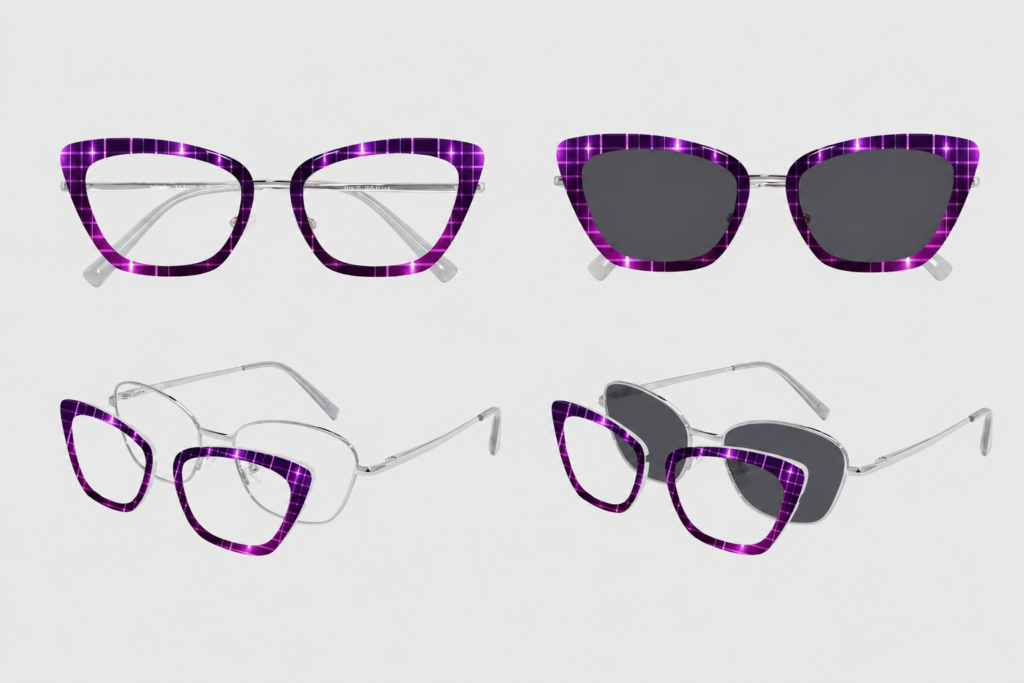
XCombo is an interchangeable eyewear system built around a metal base frame and removable snap-fit eyewear toppers.
The prescription or non-prescription lenses are installed in the base frame. Compatible toppers can then be attached over the base frame to change its visible style or, with certain sun toppers, add sunglass functionality.
The basic system works like this:
Choose a Base Frame → Add Your Lenses → Choose Compatible Toppers → Snap On a New Look
Because the topper is separate from the prescription lenses, changing the topper does not change your underlying vision correction.
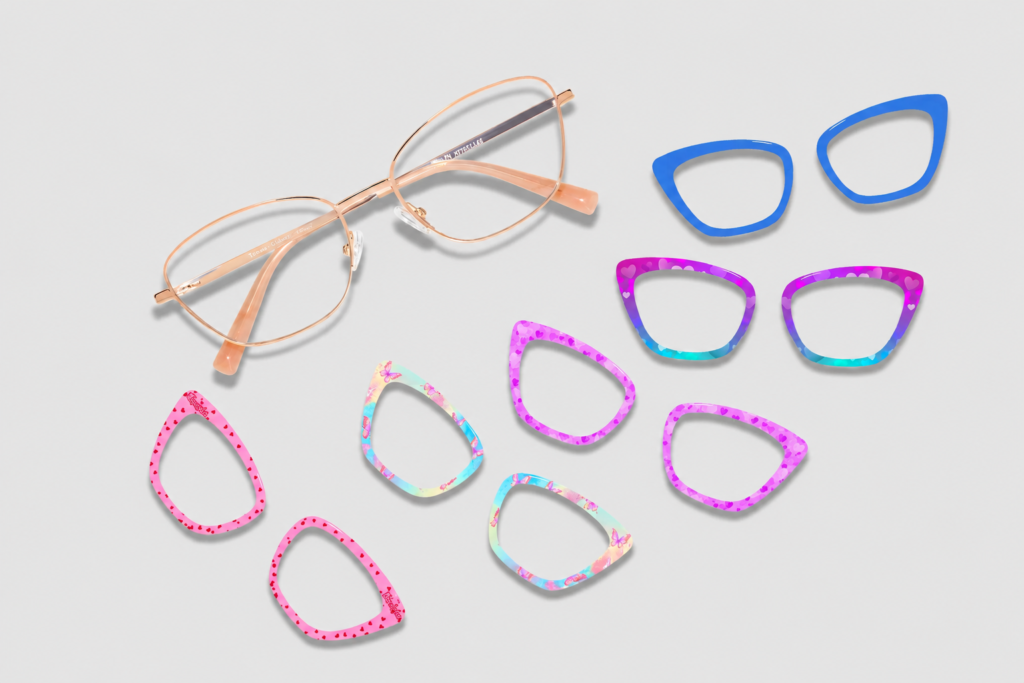
XCombo toppers are available in different colors, patterns, and designs, allowing one compatible base frame to support a wide range of visual combinations.
Certain compatible toppers can also be configured with polarized sun lenses, allowing the prescription base frame and topper to work together as sunglasses.
What Types of Lenses Can Interchangeable Base Frames Use?
One of the major advantages of a well-designed interchangeable eyewear system is that the base frame remains a fully functional optical frame.
Depending on the specific frame, prescription, and optical requirements, compatible base frames can support a wide range of prescription and non-prescription lens options.
These may include:
Single-Vision Lenses
Single-vision lenses use one optical power across the lens and are commonly prescribed for:
- Myopia, or nearsightedness
- Hyperopia, or farsightedness
- Other single-distance vision correction needs
Progressive Lenses
Progressive lenses provide multiple vision zones within one lens, allowing correction for distance, intermediate, and near vision without visible segment lines.
Bifocal Lenses
Bifocals combine two distinct optical powers, typically providing distance vision in the main portion of the lens and near vision in a separate segment.
Non-Prescription Lenses
A base frame can also be fitted with plano, or non-prescription, lenses for people who do not require vision correction.
Photochromic Lenses
Photochromic lenses react to ultraviolet light and darken outdoors before returning toward a clearer state indoors.
They can provide another way to add adaptive sun protection while retaining the interchangeable frame concept.
Color-Tinted Lenses
Tinted lenses can be used for aesthetic, comfort, or sunwear purposes depending on the lens configuration.
They are available in different colors and tint intensities.
Different Lens Refractive Indices
Prescription lenses can also be made using different refractive-index materials.
Higher-index lens materials can allow stronger prescriptions to be produced with thinner lens profiles compared with some conventional materials.
The appropriate lens index depends on factors including:
- Prescription strength
- Frame dimensions
- Lens design
- Desired thickness
- Optical requirements
Because the prescription lenses remain in the base frame, these optical choices are largely independent of the decorative topper collection.
That is a key distinction of interchangeable eyewear:
The base frame is the optical platform. The topper is the interchangeable style or functional layer.
Are Interchangeable Glasses Prescription Glasses?
They can be.
Whether interchangeable glasses support prescription lenses depends on the eyewear system and the base frame.
With XCombo, prescription lenses are fitted into the metal base frame rather than the topper.
Depending on the selected frame and prescription requirements, the base frame can support a variety of prescription and non-prescription lens configurations.
These can include options for nearsightedness, farsightedness, single-vision correction, progressive or multifocal needs, bifocals, photochromic lenses, tinted lenses, and different lens indices.
The topper remains separate from the main prescription lenses.
This separation is one of the central ideas behind interchangeable eyewear:
The base frame handles vision correction. The topper changes the style or adds compatible functionality.
As a result, changing a standard decorative topper does not change your prescription.
Can You Use Progressive or Multifocal Lenses With Interchangeable Glasses?
Some interchangeable eyewear systems can support progressive, multifocal, or bifocal lenses when the compatible base frame is suitable for them.
Progressive and multifocal lenses require accurate optical measurements and proper fitting, so frame selection is particularly important.
Factors such as:
- Lens height
- Pupillary distance
- Frame dimensions
- Prescription
- Fitting position
can all affect the final lens configuration.
With XCombo, compatible base frames can support a range of lens types, including single-vision and multifocal options.
If you have a strong prescription, progressive prescription, prism correction, or other complex optical requirements, it is always worth confirming the specific frame and lens compatibility before ordering.
Do Glasses Toppers Have Prescription Lenses?
Normally, no.
The prescription lenses belong in the base frame, not in the topper.
A standard decorative glasses topper is primarily designed to change the appearance of the eyewear.
However, some toppers can incorporate polarized sun lenses.
In this configuration:
- The base frame continues to provide your prescription correction.
- The topper provides the polarized sunglass layer.
- The combined system functions as prescription sunglasses while the topper is attached.
Remove the sun topper, and the base frame returns to its regular everyday configuration.
This is different from manufacturing a second complete pair of prescription sunglasses because the same prescription base frame continues to be used.
Are Glasses Toppers the Same as Clip-On Sunglasses?
Not necessarily.
Both products involve attaching an additional component to existing glasses, but their design and purpose can be different.
A traditional clip-on sunglass attachment is primarily designed to position tinted lenses in front of an existing pair of prescription glasses.
An interchangeable eyewear topper is part of a modular frame system and is generally designed to integrate with a specific compatible base frame.
Many toppers are decorative and contain no lenses at all.
Others may combine the interchangeable frame concept with polarized sun lenses, allowing them to change both the appearance and sunwear functionality of the base glasses.
So while polarized sun toppers and traditional clip-on sunglasses can serve a similar practical purpose, they are not necessarily the same type of product or attachment system.
Are Interchangeable Glasses Worth It?
That depends largely on how you use your glasses.
Interchangeable eyewear may make sense if you:
- Wear prescription glasses every day
- Like changing your accessories frequently
- Want different frame looks without maintaining several complete prescription pairs
- Enjoy matching eyewear with outfits or occasions
- Prefer a modular eyewear system
- Want a compact collection of styles that share one base frame
- Want the option to convert compatible prescription glasses into sunglasses with a sun topper
Traditional glasses may still be the better choice if you strongly prefer one fixed style or want multiple complete backup pairs with independent prescription lenses.
The value of interchangeable glasses comes from flexibility and modularity, not simply from owning more frame pieces.
What Should You Look for When Choosing Interchangeable Glasses?
If you are comparing interchangeable eyewear systems, consider more than just the number of available toppers.
Base Frame Quality
The base frame is the part you wear every day, so material, fit, hinges, nose support, and overall construction matter.
It is also the optical foundation of the system, so compatibility with your preferred prescription and lens type should be considered.
Attachment Method
Consider whether the system uses magnets, snap-fit engagement, clips, or another mechanism.
Think about how frequently you plan to switch toppers and what type of connection you prefer.
Topper Compatibility
Toppers are usually designed for specific base-frame shapes and sizes.
In systems with more integrated mechanical connections, compatibility is particularly important because the grooves, notches, retaining points, and contours of the topper need to align correctly with the corresponding base frame.
Always check compatibility before purchasing additional toppers.
Prescription and Lens Options
If you need vision correction, confirm that the base frame supports your prescription and preferred lens type.
Depending on your needs, you may want to consider:
- Single-vision lenses
- Progressive lenses
- Bifocals
- Different lens indices
- Photochromic lenses
- Tinted lenses
- Non-prescription lenses
Sunwear Options
If you regularly need sunglasses, check whether the system offers compatible sun toppers.
A polarized sun topper can be particularly useful because it allows the same prescription base frame to transition from everyday eyewear to sunglass use.
Topper Variety
Look at the actual range of colors, patterns, materials, and designs available for your chosen frame shape.
A modular system becomes more useful when you genuinely like the topper options available for it.
Overall Appearance
Some interchangeable systems make the additional topper visually obvious, while others are designed to create a more integrated frame-and-topper appearance.
This is largely a matter of personal preference, but it is worth comparing how the system looks from the front, side, and three-quarter angles.
Interchangeable Glasses vs. Buying Multiple Pairs
Interchangeable eyewear and owning several complete pairs of glasses solve the same basic desire in different ways: having more than one look or function.
Multiple complete pairs give you independent glasses that can be worn separately and can also serve as backups.
Interchangeable glasses concentrate more of the optical investment in one main base frame and lens setup, then expand the styling and certain functional options through toppers.
For example, one prescription base frame might be used with:
- A neutral everyday topper
- A bold patterned topper
- A translucent fashion topper
- A polarized sun topper
Neither approach is universally better.
For someone who wants multiple independent backup glasses, several complete pairs can make sense.
For someone primarily interested in changing the visible style—or adding compatible sunglass functionality while keeping the same prescription base frame—interchangeable eyewear may offer a more flexible approach.
Frequently Asked Questions About Interchangeable Glasses
What are interchangeable glasses?
Interchangeable glasses are modular eyewear systems that use a primary base frame together with removable toppers or top frames. The base frame holds the prescription or non-prescription lenses, while compatible toppers change the appearance or add certain functions.
What is a glasses topper?
A glasses topper is a removable outer frame designed to attach to a compatible base frame. It may also be called a top frame or eyewear topper.
Most toppers do not contain prescription lenses.
Do interchangeable glasses use magnets?
Some do, but not all.
Magnetic interchangeable glasses use magnets to attach the topper. Other systems use mechanical connections such as snap-fit designs.
XCombo uses a snap-fit topper connection rather than a magnetic connection.
How does a snap-fit glasses topper work?
A snap-fit topper uses mechanical engagement rather than magnetic attraction.
Depending on the design, grooves, notches, retaining structures, or stops in the topper engage with corresponding parts of the base frame, such as the rim wire, endpieces, or bridge.
This allows the topper to connect closely with the geometry of the compatible base frame.
Do glasses toppers contain prescription lenses?
Standard decorative toppers normally do not.
The prescription lenses are installed in the base frame.
However, some toppers can contain polarized sun lenses. When attached to a prescription base frame, they can transform the combined eyewear into prescription sunglasses.
What types of prescription lenses can interchangeable glasses use?
Depending on the base frame and optical requirements, interchangeable glasses may support single-vision lenses, progressive or multifocal lenses, bifocals, photochromic lenses, tinted lenses, non-prescription lenses, and different lens-index materials.
Can interchangeable glasses work for nearsightedness or farsightedness?
Yes, when the base frame is compatible with the required prescription.
The prescription correction is built into the lenses installed in the base frame rather than into the interchangeable topper.
Can you change glasses toppers every day?
Yes, if the system is designed for repeated swapping and the topper is compatible with the base frame.
Many people use different toppers to match clothing, activities, seasons, or personal style.
Are toppers universal?
Usually not.
A topper is generally designed to fit a specific base-frame model, shape, or size.
This is especially important with precisely integrated snap-fit systems, where the topper and base frame need to align at specific connection points.
Can interchangeable glasses become sunglasses?
Some can.
If the system offers a compatible topper with polarized sun lenses, it can be attached over a prescription base frame so that the combined eyewear functions as sunglasses while retaining the underlying prescription correction.
What is the difference between magnetic and snap-fit toppers?
Magnetic toppers rely on magnetic attraction between the topper and base frame.
Snap-fit toppers rely on mechanical engagement between compatible frame components.
The best option depends on the system design, desired attachment feel, frequency of swapping, appearance, and personal preference.
A More Flexible Way to Wear Glasses
For decades, choosing glasses usually meant choosing one frame design and living with that look until the next pair.
Interchangeable glasses introduce a different idea.
Keep the base frame and prescription lenses you depend on, while changing the visible style—or even adding compatible sunglass functionality—around them.
The base frame can remain a serious optical platform capable of supporting a wide range of lens types and prescriptions.
The topper then becomes the interchangeable layer.
That separation makes it possible to think about eyewear differently:
Vision correction does not have to determine one fixed style.
Whether you prefer simple solid colors, translucent designs, bold patterns, or polarized sun toppers, modular eyewear can make glasses feel less like a fixed medical device and more like an adaptable part of your everyday style.
At XCombo, that idea is built around a metal base frame and snap-fit interchangeable topper system, allowing one compatible prescription base frame to support many different looks and functions.
Explore XCombo interchangeable base frames and eyewear toppers to build a combination that fits your prescription, your wardrobe, and your lifestyle.
Join the Conversation on Reddit:
Share this post
How to Choose Interchangeable Glasses: A Complete Buying Guide
Traditional eyewear usually means choosing one frame style and wearing it every day. If you want a different color, pattern, or look,...
XCombo vs Pair Eyewear: Snap-Fit vs Magnetic Interchangeable Glasses
Interchangeable glasses let you change the look of your eyewear without replacing your prescription lenses every time you want a different color,...
What Are Glasses Toppers? A Complete Guide to Eyewear Toppers, Top Frames & How They Work
Glasses toppers are removable outer frames designed to attach to a compatible pair of base glasses, allowing you to change the appearance—or,...
Magnetic vs Snap-Fit Glasses Toppers: What’s the Difference?
The way people wear glasses is changing.Traditional eyewear usually means choosing one frame style and wearing it every day. However, interchangeable eyewear...
How XCombo’s Snap-Fit Topper System Works: The Technology Behind Interchangeable Eyewear
Traditional eyewear is designed around one simple idea: one frame, one style.But modern eyewear users increasingly want more flexibility. They want glasses...