
A Breakthrough for High Myopia: How Custom Eyeglass Frames Make Thick Lens Edges “Disappear”
For people with high myopia, buying eyeglasses has long been a frustrating experience. While vision correction technology has improved dramatically over the years, one persistent problem remains: thick lens edges.
Many individuals with strong prescriptions know the struggle well. You find a stylish frame, try it on, and suddenly the lenses look bulky, heavy, or visibly thick from the side. The glasses may distort facial proportions, slide down the nose, or simply feel uncomfortable after hours of wear.
But today, a growing solution is changing the experience for high-prescription wearers: custom-designed eyeglass frames engineered to reduce visible lens thickness by narrowing the frame surface.
Rather than relying solely on expensive lens materials, modern optical design focuses on geometry — reshaping the frame itself to make lens edges appear nearly invisible.
This article explains how customized frames work, why frame width dramatically affects lens thickness, and how intelligent design can transform both comfort and appearance for people with high myopia.
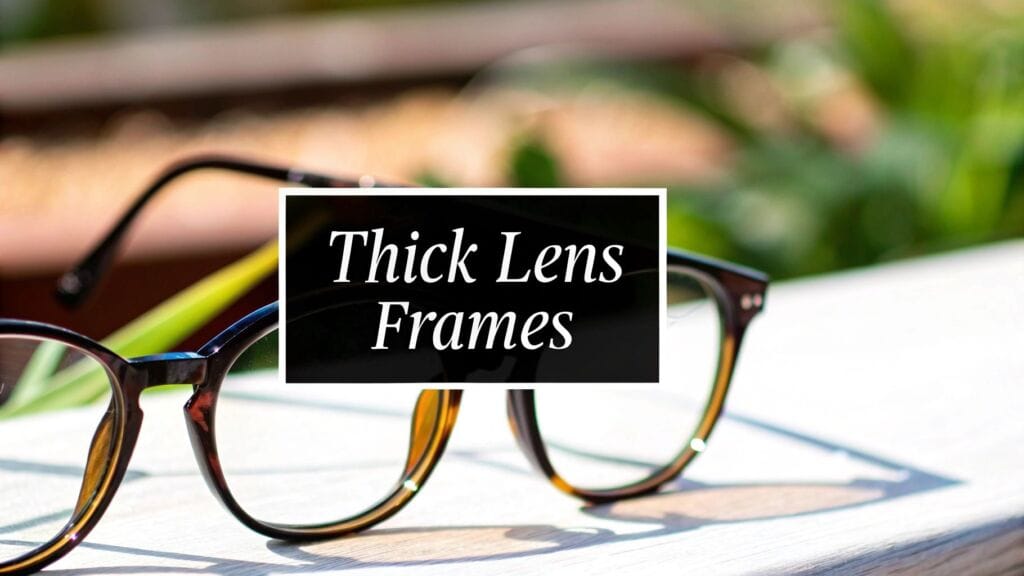
Understanding High Myopia and Its Optical Challenges
High myopia generally refers to prescriptions stronger than −6.00 diopters. At this level, lenses must bend light significantly to correct vision, requiring thicker edges compared to mild prescriptions.
Unlike farsighted lenses, which are thick in the center, myopic lenses are:
- Thin in the middle
- Thick around the outer edge
This edge thickness increases rapidly as prescription strength rises.
For example:
- −2.00 lenses appear relatively thin.
- −6.00 lenses show noticeable edge thickness.
- −10.00 or higher lenses can become dramatically thick without proper design.
The result is not only aesthetic concerns but also physical and optical challenges.
Why High-Prescription Lenses Become Thick
The thickness of a lens depends on several factors:
- Prescription strength
- Lens material refractive index
- Frame size
- Pupillary distance alignment
- Lens shape and curvature
Most people focus only on material index (such as 1.67 or 1.74 lenses), but frame size often has an even greater impact.
This is where customized frames make a powerful difference.
The Geometry Behind Lens Thickness
Lens thickness increases as the distance between the optical center and lens edge grows.
In simpler terms:
The larger the frame lens area, the thicker the edges must be.
When lenses extend farther away from the pupil, more corrective power is required across a wider surface, increasing edge bulk.
Therefore, reducing lens diameter directly reduces thickness.
What Does “Narrowing the Frame Surface” Mean?
Custom frames designed for high myopia intentionally reduce unnecessary lens area.
This does not mean making glasses look small or unfashionable. Instead, designers carefully adjust proportions to:
- Reduce lens width
- Optimize lens height
- Align optical centers precisely
- Maintain balanced facial aesthetics
The result is a frame that visually appears normal but structurally minimizes lens edge thickness.
Why Standard Frames Often Fail High Myopia Wearers
Mass-produced frames are typically designed for average prescriptions.
Common problems include:
- Oversized lenses driven by fashion trends
- Wide frame fronts
- Low bridge positioning
- Poor optical center alignment
While these designs look appealing in displays, they unintentionally exaggerate lens thickness for strong prescriptions.
High myopia requires a different design philosophy.
The Science of Edge Reduction Through Frame Geometry
When frame width decreases even slightly, lens thickness drops significantly.
Consider this simplified comparison:
- Large frame lens diameter: 55 mm
- Optimized custom diameter: 48 mm
That small reduction can decrease edge thickness by several millimeters — a major visual improvement.
Because thickness increases exponentially rather than linearly, small dimensional changes create large benefits.
Optical Center Alignment: The Hidden Advantage
Custom frames also align lenses precisely with the wearer’s pupillary distance.
Benefits include:
- Reduced peripheral distortion
- Thinner edges
- Improved clarity
- Better weight balance
Standard frames often require lenses to be decentered during cutting, which increases edge thickness on one side.
Customization eliminates this inefficiency.
How Custom Frames Make Edges Appear “Invisible”
The illusion of thinner lenses comes from three combined effects:
1. Reduced Lens Diameter
Less material equals thinner edges.
2. Balanced Edge Distribution
Proper alignment prevents uneven thickness.
3. Frame Coverage
Frame rims strategically conceal remaining thickness.
Together, these factors visually hide lens bulk even at high prescriptions.
Frame Shape Matters More Than You Think
Not all shapes perform equally for high myopia.
Best Shapes
- Round or oval frames
- Soft rectangular designs
- Slightly narrower widths
These minimize edge distance from the optical center.
Shapes to Avoid
- Oversized square frames
- Aviator styles with wide lenses
- Extremely flat horizontal designs
These increase edge thickness dramatically.
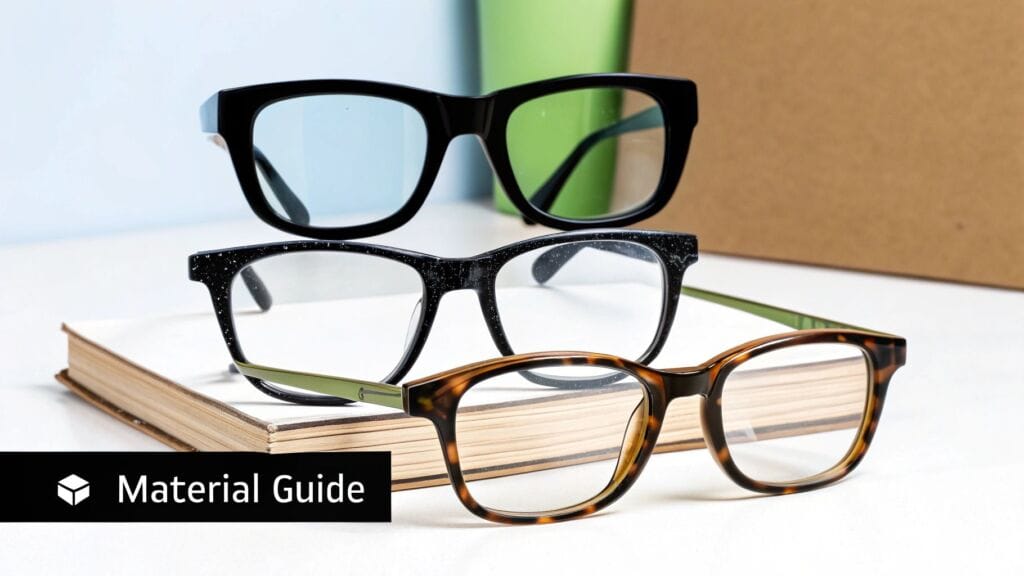
The Role of Lens Index vs Frame Design
High-index lenses reduce thickness by bending light more efficiently.
However, material alone cannot compensate for oversized frames.
A smart comparison:
- High-index lens + large frame = still thick edges
- Standard high-index lens + optimized frame = noticeably thinner result
Frame geometry often delivers greater visual improvement than material upgrades alone.
Weight Reduction and Comfort Benefits
Thinner edges mean lighter glasses.
Advantages include:
- Reduced nose pressure
- Less slipping
- Improved long-term comfort
- Better stability during movement
For people wearing glasses all day, weight reduction significantly improves quality of life.
Facial Aesthetics and Proportion Balance
Thick lenses can create visual distortion known as the “minification effect,” making eyes appear smaller behind glasses.
Custom frames help by:
- Reducing lens thickness
- Improving lens curvature balance
- Maintaining natural facial proportions
The result feels more flattering and natural.
Custom Bridge Design for High Myopia
Bridge positioning affects how lenses sit relative to the eyes.
Customized bridges allow:
- Better optical alignment
- Reduced decentering
- Improved comfort
Small structural changes create measurable optical benefits.
Rim Thickness and Material Choices
Frame rims also contribute to the illusion of thin lenses.
Recommended options:
- Slightly thicker acetate rims
- Structured metal-acetate hybrids
- Matte finishes that reduce reflections
Thin wire frames may expose lens edges more visibly.
Advanced Lens Pairing with Custom Frames
Customization works best when paired with modern lens technologies:
- Aspheric lens designs
- Freeform digital surfacing
- Edge polishing
- Anti-reflective coatings
These enhancements complement frame optimization rather than replace it.
Psychological Confidence and Appearance
Eyewear influences self-perception.
Many high myopia wearers report increased confidence when lens thickness becomes less noticeable.
Benefits extend beyond vision correction:
- Improved professional appearance
- Greater style freedom
- Reduced self-consciousness
Design affects emotional comfort as much as physical comfort.
Why Customization Is Becoming More Popular
Advances in digital measurement tools allow optical designers to create frames tailored to individual facial geometry.
Modern customization considers:
- Face width
- Nose shape
- Eye spacing
- Prescription strength
- Lifestyle needs
This personalized approach replaces one-size-fits-all eyewear.
Common Misconceptions About High-Myopia Glasses
Myth: Only expensive lenses solve thickness.
Reality: Frame design plays an equally important role.
Myth: Small frames look outdated.
Reality: Properly proportioned frames appear modern and intentional.
Myth: Rimless glasses make lenses lighter.
Reality: Rimless designs often expose thickness more visibly.
Step-by-Step Process of Getting Custom Frames
- Prescription analysis.
- Facial measurement scanning.
- Frame dimension optimization.
- Material selection.
- Lens pairing.
- Precision fitting.
Each step contributes to edge reduction.
Real-Life Example
A wearer with −9.00 prescription switches from a large fashion frame to a customized narrower frame.
Results often include:
- Edge thickness reduction of 25–40%
- Noticeably lighter feel
- Improved facial balance
- Less visible lens distortion
The improvement can be dramatic without changing prescription strength.
Maintenance Tips for High-Myopia Glasses
Proper care maintains visual performance:
- Clean lenses regularly.
- Avoid high heat exposure.
- Store in protective cases.
- Adjust frames periodically.
Well-maintained alignment preserves thickness optimization.
Future Innovations in Custom Eyewear
Emerging technologies include:
- AI-assisted frame design
- 3D-printed custom frames
- Ultra-light composite materials
- Precision biometric measurements
The trend moves toward eyewear engineered specifically for each wearer rather than mass production.
Choosing the Right Optical Provider
Look for providers offering:
- Detailed measurements
- Prescription-focused frame recommendations
- Custom sizing options
- Experience with high prescriptions
Expert guidance ensures optimal results.
Who Benefits Most from Narrowed Frame Designs?
Customization is especially helpful for:
- Prescriptions above −6.00
- Individuals sensitive to heavy glasses
- Professionals seeking refined appearance
- Long-hour screen users
- First-time high-index lens buyers
The stronger the prescription, the greater the benefit.
Final Thoughts
For decades, people with high myopia accepted thick lenses as unavoidable. Today, that assumption is changing.
By redesigning the frame itself — narrowing lens surfaces, optimizing geometry, and aligning optical centers precisely — custom eyewear can dramatically reduce visible edge thickness. Instead of relying solely on advanced lens materials, modern optical solutions use intelligent design to make lenses appear lighter, thinner, and more discreet.
The result is not just clearer vision, but a better overall wearing experience: improved comfort, balanced aesthetics, and renewed confidence.
High prescriptions no longer need to limit style choices or visual appearance. With thoughtfully engineered custom frames, even strong lenses can look refined and almost invisible — proving that sometimes the biggest improvement comes not from changing the lens, but from changing the frame around it.
Share this post
2026 Spring/Summer Fashion Trends: When Retro Small-Frame Glasses Meet the Underarm Bag
Fashion has always had a talent for bringing the past back in unexpected ways.A silhouette that once belonged to another decade can...
Soft Aesthetics for Girls with Square Faces: How Rounded Handbags and Gentle Eyeglass Frames Soften Facial Lines
A square face can be striking, elegant, and full of character. Defined by a broader forehead, a relatively straight jawline, and noticeable...
How to Buy Prescription Glasses Online on XCombo
Looking to buy glasses online? XCombo makes it easy to get stylish, high-quality glasses tailored to your prescription. Follow this simple step-by-step...
The Executive Style Code: A Career Guide to Suits, Briefcases, and Sophisticated Eyewear
In the modern workplace, professional style is about much more than wearing expensive clothes.The strongest business wardrobe communicates something before you say...
Street-Cool Style: How to Make Motorcycle Jackets, Belt Bags, and Futuristic Sunglasses Stand Out
Street fashion has never been about following every rule.It is about knowing which rules to break.A motorcycle jacket, a compact belt bag,...

The Art of Color Coordination: How to Match Your Bag With Your Eyeglass Frames for an Effortlessly Sophisticated Look
Fashion is often about the little details.A beautifully tailored outfit can look polished, yet something may still feel incomplete. The reason is...
Dating Night Style Secrets: The Perfect Collision of an Elegant Cocktail Dress, a Chain Evening Bag, and Sophisticated Semi-Rimless Glasses
Dating night is about more than choosing an outfit. It is about creating an impression without looking like you tried too hard....
Effortless French Elegance: The Perfect Pairing of Knitwear, Tote Bags, and Cat-Eye Glasses
There is something undeniably captivating about French style.It is polished without looking overly polished, feminine without being overly delicate, and comfortable without...
A Cross-Textural Conversation: The Tactile Collision of Leather Bags, Tweed Clothing, and Wood-Frame Eyewear
Introduction: When Materials Become the Main CharacterFashion is often discussed in terms of color, silhouette, trend, and season. Yet some of the...

The Ultimate Guide to Vacation-Style Outfits: Floral Dresses, Straw Bags, and Round Sunglasses for Summer
Summer is the season of relaxed mornings, warm afternoons, outdoor dinners, weekend getaways, and long-awaited vacations. It is also the perfect time...
The Romance of Earth Tones in Fall: The Color Aesthetics of Trench Coats, Saddle Bags, and Tea-Tinted Sunglasses
Introduction: Falling in Love With the Colors of AutumnThere is something irresistibly romantic about autumn fashion.As summer fades, bright colors gradually give...
Best Glasses for Your Face Shape: Round, Square, Oval & More
Introduction: The Right Glasses Can Transform Your Entire AppearanceChoosing a pair of glasses is about much more than simply correcting your vision....