

The Zenith of Lightweight: The “Black Tech” Revolution in Customized Eyewear Materials
For the discerning eyewear wearer, the struggle has always been a trade-off between personality and pressure. We crave the bold, architectural lines of custom-designed frames, but our nasal bridges and temples often pay the price in the form of indentations, headaches, and the dreaded "frame fatigue."
However, we are currently witnessing a seismic shift in the optical industry. The "Lightweight Limit" is no longer a distant goal; it is a reality driven by Customized Engineering and a new suite of "Black Tech" materials. We are moving beyond "one-size-fits-all" plastic and heavy metals into a world where aerospace-grade alloys, bio-synthetic polymers, and 3D-printed lattices are tailored to the exact contours of an individual's face.
In this deep dive, we will explore the revolutionary materials pushing the boundaries of bespoke eyewear and why the future of glasses is both invisible in weight and invincible in strength.
1. Beyond the Scale: Why "Custom" Changes the Weight Game
When you buy "off-the-shelf" glasses, the manufacturer must over-engineer the frame to survive a thousand different face shapes. This usually means thicker hinges, heavier bridges, and more material than you actually need to ensure the frame doesn't snap under generic stress.
Bespoke eyewear flips this script. By using 3D facial scanning to map your unique cranial topography, designers can remove excess material where it isn't needed for structural support. When you combine this "minimalist geometry" with high-performance materials, you achieve a level of comfort that feels less like a medical device and more like a second skin.
The weight of a frame isn't just a number on a scale; it's about distribution. A custom-fit frame sits on the "sweet spot" of your nasal bone, making even a substantial-looking frame feel weightless.
2. Beta-Titanium: The Aerospace "Skeleton"
If there is a "holy grail" of bespoke eyewear metals, it is Beta-Titanium ($\beta$-Titanium). While standard titanium is impressive, $\beta$-titanium is an alloy processed to reach a specific crystalline state that offers unparalleled flexibility.
The Science of Memory
$\beta$-Titanium possesses what engineers call "Shape Memory." In a custom-fit frame, this means the temples (arms) can be engineered to a thickness of just 0.5mm—barely thicker than a needle—yet they maintain enough "spring tension" to hold the glasses securely during a morning jog.
- Density: Roughly $4.5g/cm^3$ (nearly half the weight of stainless steel).
- Black Tech Edge: It is completely biocompatible (hypoallergenic) and corrosion-resistant, making it the perfect material for the custom-curved bridge that sits against your skin. It won't react with sweat or skin oils, ensuring the "new car" finish lasts for years.
3. High-Density Acetate (HD) and the "Thin-Bold" Paradox
For those who love the "intellectual" look of thick frames but hate the "heavy brow" feeling, High-Density (HD) Acetate is the answer.
Traditional acetate is porous and requires a thick profile to remain stable. HD Acetate, however, undergoes a high-pressure compression process that increases its molecular density while reducing its thickness.
- The Paradox: This allows a custom designer to create a frame that looks like a classic 1950s thick-rimmed style but is actually 35% thinner and 40% lighter than standard plastic frames.
- The Custom Advantage: Because HD acetate is more stable, it holds a "bespoke adjustment" (the specific wrap and angle tailored to your ears) much longer than cheap plastics, which tend to warp or "creep" over time.
4. The 3D-Printed Revolution: Polyamide 12 and SLS Tech
The true "Black Tech" frontier of lightweight eyewear is Selective Laser Sintering (SLS) using Polyamide 12 (PA12).
Instead of cutting a frame out of a slab of material (which creates waste and unnecessary weight), SLS "grows" the frame layer by layer from a fine powder using a high-precision laser.
Hollow Core Engineering
In bespoke 3D printing, we can actually design frames with hollow internal structures. Imagine a frame arm that looks solid but is internally a honeycomb lattice. This reduces weight to almost nothing while maintaining the strength of a solid beam.
- Micro-Texturing: 3D printing allows for a "porous" finish that grips the skin naturally. This creates a "friction-lock" effect, meaning your glasses won't slide down even if you’re sweating—all without needing heavy rubber inserts.
5. Carbon Fiber & Graphene: The Ultimate Strength-to-Weight Ratio
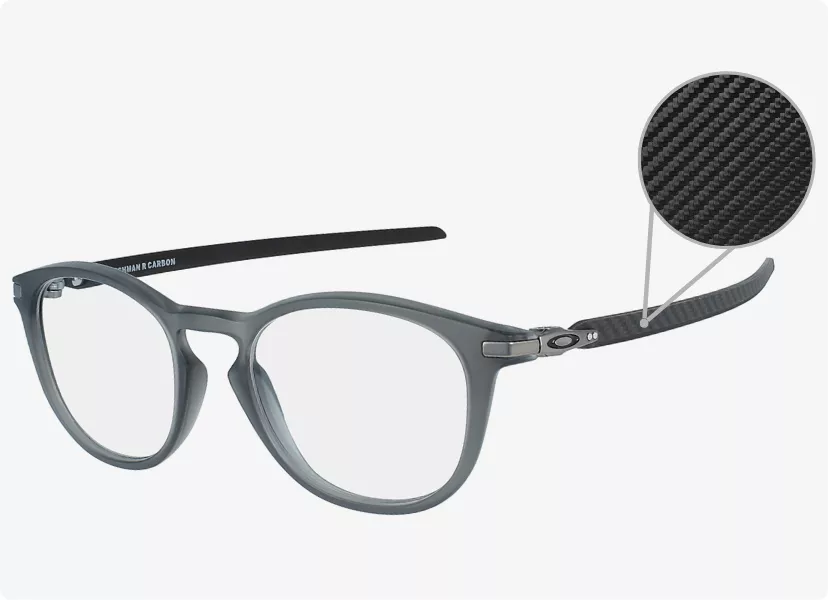
For the ultimate "tech-wear" enthusiast, custom frames are now being crafted from Carbon Fiber Composites and even Graphene-infused resins.
Note: Carbon fiber is 5 times stronger than steel but weighs a fraction of it. When used in custom eyewear, layers are hand-laid to ensure the "weave" provides maximum strength at the hinges—the most common point of failure.
Material Comparison for Bespoke Frames
6. The Engineering of Balance: The "Nose-Heavy" Fix
A common complaint with custom glasses is that even "light" frames feel heavy if the lenses are thick. This is where Weight Distribution Engineering comes in.
Using "Black Tech" materials allows designers to use a "Counter-Balance" strategy. By using a slightly denser material for the temple tips (behind the ears) and an ultra-light $\beta$-titanium for the front, the center of gravity is shifted backward.
Pro-Tip: In a perfectly balanced bespoke frame, the weight is distributed 70/30 towards the ears, effectively lifting the pressure off the sensitive bridge of the nose.
7. Bio-Synthetics: The Eco-Lightweight Frontier
As we look toward the future, "Black Tech" is also becoming "Green Tech." Custom manufacturers are now utilizing Bio-based polymers derived from castor beans or wood pulp. These materials aren't just sustainable; they are inherently lighter than petroleum-based plastics. They offer a "warm" tactile feel that mimics natural horn but with the precision and longevity of modern manufacturing.
8. Why Your Next Pair Should Be "Material-First"
When you invest in custom eyewear, you aren't just paying for a "look." You are paying for the elimination of a daily distraction.
- Eliminate Sinus Pressure: Light materials prevent the "heavy head" feeling by reducing pressure on the ethmoid and maxillary sinuses.
- Skin Health: Advanced alloys prevent the oxidation (the "green mark") that happens with cheap metals.
- Visual Stability: Lightweight frames move less. When your frames stay perfectly aligned with your pupils, your brain and eyes strain less to compensate for blur.
9. Conclusion: The Invisible Masterpiece
The evolution of materials in the custom eyewear space is a journey toward the "invisible." The ultimate goal of "Black Tech" is to create a frame so light, so perfectly balanced, and so anatomically correct that you forget you are wearing it five seconds after putting it on.
Whether it's the spring of a titanium alloy or the hollow lattice of a 3D-printed temple, the technology is there to serve your vision, not weigh it down.
Ready to find your "Zero-Gravity" fit?
Would you like me to help you compare the pros and cons of 3D-printed vs. Titanium bespoke frames based on your specific prescription strength?
Share this post
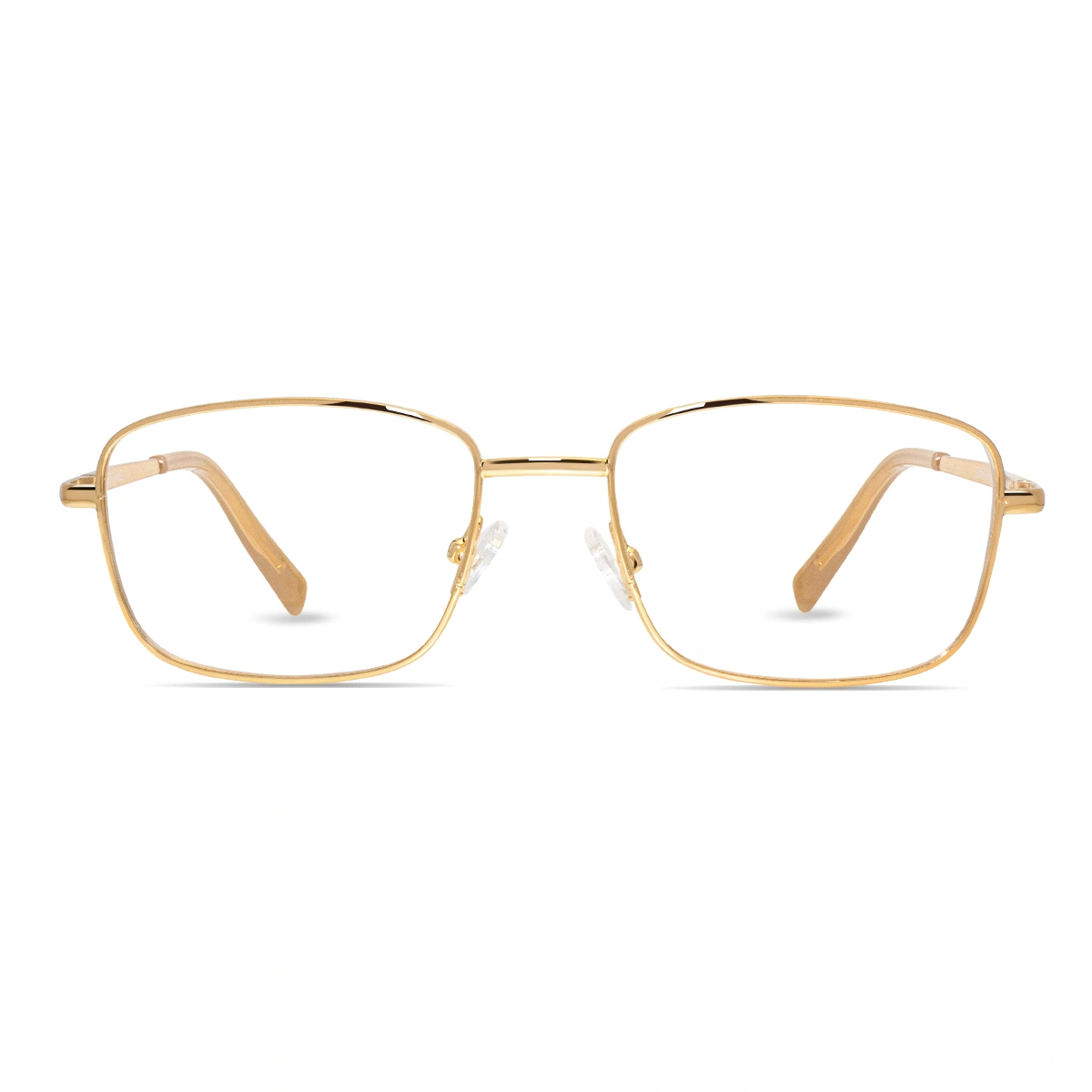
Soline Classic Gold Base Frame – Wide Rectangle






Living a Multifaceted Life: How Custom Modular Eyewear Defines Your Personal Identity
Yet for years, eyewear has tried to force all these identities into one fixed frame.In a world where people change roles, moods,...
Are Pink Glasses in Style?
Pink glasses are a timeless symbol of charm and personality. They evoke feelings of compassion, love, and hope, making them a popular...
One-Second Color Switch
How to Match Your Glasses Frame to Today’s Outfit—EffortlesslyLet’s be honest.You don’t wear the same outfit every day.Some days it’s clean and...
Nerd Glasses: Choosing the Best Pair to Match Your Style
Nerd glasses have evolved from being a stereotype to a trendy fashion statement. With their unique designs and bold frames, these glasses...
How to Measure Pupillary Distance(PD)?
What Is Pupillary Distance(PD)?Pupillary Distance (PD) is the measurement, in millimeters, between the centers of your two pupils. This measurement is essential...
The Ultimate Value Champion - How One Pair of Modular Glasses Can Handle Work, Workouts, and Dates
Real value is about buying smarter.We expect one smartphone to replace a camera, a GPS, a notebook, and a wallet.We expect one...