

Are Ultrasonic Cleaners Worth Buying? A Complete Deep-Cleaning Review for Eyeglasses at Home
For anyone who wears glasses daily, one frustration never seems to disappear:
No matter how often you wipe your lenses, they never stay perfectly clean for long.
Fingerprints, facial oils, dust, makeup residue, skin flakes, and microscopic debris slowly build up around nose pads, hinges, frame edges, and lens coatings. Traditional microfiber cloths can remove surface smudges temporarily, but they often fail to clean the tiny hidden areas where grime accumulates over time.
That is why ultrasonic cleaners have become increasingly popular among homeowners, eyewear users, watch collectors, jewelry owners, and even tech enthusiasts.
Originally associated mostly with jewelry stores, optical shops, and professional laboratories, ultrasonic cleaning machines are now widely available for home use. Social media videos showing dirty glasses becoming spotless in minutes have fueled even more curiosity.
But many consumers still ask an important question:
Are ultrasonic cleaners actually worth buying for everyday eyeglass cleaning?
The answer depends on understanding how ultrasonic cleaning works, what it does well, what it cannot do, and whether the real-world results justify the cost.
This guide takes a deep, practical look at ultrasonic cleaners for eyeglasses, covering cleaning performance, safety, convenience, limitations, maintenance, and buying considerations for home users in 2026.

1. What Is an Ultrasonic Cleaner?
An ultrasonic cleaner is a device that uses high-frequency sound waves to clean objects submerged in liquid.
Unlike traditional scrubbing methods, ultrasonic cleaning does not rely primarily on physical wiping or brushing.
Instead, the machine generates microscopic bubbles through a process called cavitation.
How cavitation works
Inside the cleaning tank:
- High-frequency vibrations travel through water or cleaning solution
- Tiny microscopic bubbles rapidly form and collapse
- These collapses generate localized cleaning energy
The process reaches:
- Tiny crevices
- Hinges
- Nose pad gaps
- Frame joints
- Hard-to-access surfaces
This is why ultrasonic cleaners are particularly effective for eyeglasses.
2. Why Eyeglasses Become Difficult to Clean Properly
Modern eyeglasses are more complex than many people realize.
Frames contain:
- Hinges
- Screws
- Rubber components
- Curved surfaces
- Narrow contact areas
Over time, these areas collect:
- Skin oils
- Sweat residue
- Cosmetic buildup
- Dust particles
- Air pollution residue
- Bacteria
The problem with manual cleaning
Microfiber cloths are excellent for:
- Surface smudges
- Quick polishing
But they struggle to remove:
- Embedded hinge debris
- Hardened grime
- Nose pad buildup
As a result, glasses may appear clean while still carrying hidden contamination.
3. Why Ultrasonic Cleaning Feels So Different
The first time many users try ultrasonic cleaning, they are surprised by how much dirt appears in the water—even after manually cleaning the glasses beforehand.
This happens because ultrasonic energy reaches areas cloths cannot.
Commonly cleaned hidden areas include:
- Frame joints
- Lens edges
- Nose pad brackets
- Screw recesses
- Decorative grooves
The cleaning feels deeper and more complete than surface wiping.
4. What Types of Eyeglasses Can Be Cleaned Ultrasonically?
Most modern eyeglasses are generally compatible with ultrasonic cleaning, including:
- Prescription glasses
- Sunglasses
- Reading glasses
- Blue-light glasses
- Metal frames
- Many plastic frames
However, caution matters
Not every frame or coating responds equally well.
Some delicate items may require extra care.
Generally safer materials include:
- Stainless steel
- Titanium
- Acetate
- Durable plastics
Higher-risk situations may include:
- Loose decorative elements
- Fragile vintage frames
- Damaged coatings
- Poorly attached stones or ornaments
Always check manufacturer guidance when uncertain.
5. Can Ultrasonic Cleaners Damage Lens Coatings?
This is one of the most common concerns.
Modern lenses often include:
- Anti-reflective coatings
- Blue-light filtering layers
- Scratch-resistant coatings
- UV protection coatings
The reality
A properly functioning ultrasonic cleaner used correctly is usually safe for quality eyewear.
However, problems may occur if:
- Lens coatings are already deteriorating
- The machine uses excessive power
- Harsh chemicals are added
- Cleaning cycles are excessively long
Important insight:
Ultrasonic cleaning does not usually create coating failure.
It more often exposes coatings that were already weakening.
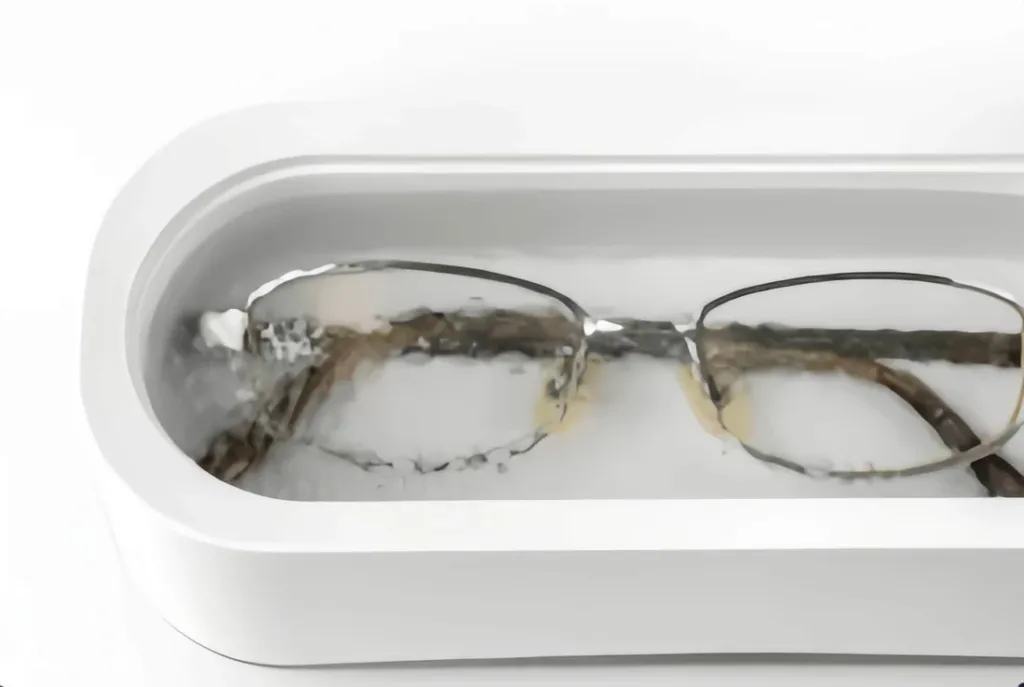
6. Cleaning Performance: What Ultrasonic Cleaners Do Best
Ultrasonic cleaners excel at removing:
- Oil buildup
- Sweat residue
- Dust
- Fine particles
- Hinge grime
- Nose pad residue
They are especially effective for:
- Daily eyewear users
- Outdoor workers
- Makeup users
- People with oily skin
The “like-new” effect
Many users notice:
- Improved clarity
- Better comfort
- Reduced odor
- Smoother hinge movement
after deep ultrasonic cleaning.
7. What Ultrasonic Cleaners Cannot Do
Despite strong marketing claims, ultrasonic cleaners are not magic devices.
They cannot:
- Repair scratches
- Restore damaged coatings
- Fix frame alignment
- Eliminate deep lens wear
- Reverse coating delamination
Important distinction
Ultrasonic cleaning improves cleanliness—not physical lens condition.
Scratched lenses remain scratched.
8. Water Alone vs Cleaning Solutions
Many home users simply use water.
And for light cleaning, water often works surprisingly well.
However, cleaning solutions improve performance
Specialized cleaning liquids help break down:
- Oils
- Grease
- Cosmetic residue
Avoid harsh chemicals
Do not use:
- Bleach
- Strong solvents
- Ammonia-heavy cleaners
These may damage lenses or machine components.
Mild cleaning formulas are safest
Many users prefer:
- Gentle optical cleaning solutions
- Mild dish soap mixtures
- Manufacturer-recommended fluids
9. Cleaning Time: How Long Should Cycles Last?
Longer is not always better.
Most eyeglass cleaning cycles require only:
- 3–5 minutes
for routine maintenance.
Extremely dirty glasses
May benefit from:
- Slightly longer cycles
- Multiple short sessions
instead of one extended session.
Overcleaning risks
Excessive cleaning may:
- Stress delicate components
- Accelerate wear on weak coatings
- Increase unnecessary exposure
Moderation matters.
10. Noise Levels and User Experience
Ultrasonic cleaners produce:
- Buzzing
- Humming
- High-frequency vibration sounds
Most modern home units are relatively quiet, though sound levels vary.
Premium models often improve:
- Vibration stability
- Noise insulation
- Tank quality
- User controls
Cheaper models may feel noticeably louder or rougher.
11. Size and Tank Capacity Considerations
Not all ultrasonic cleaners are designed only for glasses.
Many users eventually clean:
- Jewelry
- Watches
- Retainers
- Razor heads
- Metal tools
- Small electronics parts
Larger tanks provide flexibility
But they also:
- Occupy more space
- Use more water
- Cost more
For glasses-only use, compact models are usually sufficient.
12. Heating Functions: Useful or Unnecessary?
Some ultrasonic cleaners include heating systems.
Warm water can improve removal of:
- Oils
- Grease
- Cosmetic residue
But excessive heat is risky
Too much heat may affect:
- Certain coatings
- Adhesives
- Plastic frame stability
Mild warmth is generally sufficient.
13. Build Quality Matters More Than Many Buyers Expect
Ultrasonic cleaners vary dramatically in quality.
Cheap low-end models may suffer from:
- Weak transducers
- Uneven cavitation
- Short lifespan
- Poor waterproofing
Better-built units offer:
- Stable vibration performance
- More consistent cleaning
- Better durability
- Safer operation
Important reality:
A poorly designed ultrasonic cleaner may clean less effectively than careful manual washing.
14. Frequency Ratings Explained
Ultrasonic cleaners operate at different frequencies.
Lower frequencies
Typically produce:
- Stronger cavitation
- More aggressive cleaning
Better for industrial grime.
Higher frequencies
Provide:
- Gentler cleaning
- Finer-detail cleaning
- Safer treatment for delicate items
Most home eyeglass cleaners balance these factors appropriately.
15. Daily Convenience: The Biggest Advantage
The real value of ultrasonic cleaning is often convenience.
Instead of:
- Constant wiping
- Scrubbing nose pads
- Cleaning hinges manually
users simply:
- Fill the tank
- Place glasses inside
- Run a short cycle
The process feels effortless.
Why convenience changes behavior
People are more likely to clean glasses regularly when:
- The process is fast
- Results are visible
- Effort is minimal
This improves long-term eyewear hygiene.
16. Hygiene Benefits Beyond Appearance
Eyeglasses collect bacteria continuously.
Especially around:
- Nose pads
- Ear hooks
- Skin-contact surfaces
Regular deep cleaning may help reduce:
- Skin irritation
- Odor buildup
- General contamination
This became especially important after global hygiene awareness increased in recent years.
17. Are Ultrasonic Cleaners Good for Expensive Designer Glasses?
High-end eyewear owners are often cautious.
Understandably so.
The good news
Quality designer frames are often professionally ultrasonic-cleaned in optical shops already.
But caution still applies
Avoid ultrasonic cleaning if:
- Frames are loose or damaged
- Decorative stones are unstable
- Coatings are visibly deteriorating
When uncertain, consult the eyewear manufacturer.
18. Maintenance Requirements for Ultrasonic Cleaners
The machines themselves require care too.
Basic maintenance includes:
- Emptying dirty water
- Wiping the tank
- Avoiding mineral buildup
- Using appropriate cleaning fluids
Neglect causes:
- Reduced cleaning efficiency
- Odor buildup
- Component wear
Fortunately, maintenance is usually simple.
19. Who Benefits Most From Buying One?
Ultrasonic cleaners make the most sense for:
- Daily eyeglass wearers
- Families with multiple glasses users
- People wearing makeup regularly
- Sunglass collectors
- Watch and jewelry owners
- Contact lens accessory users
Less essential for:
- Occasional eyewear users
- Minimal-use reading glasses
- Users comfortable with manual cleaning
20. Are Ultrasonic Cleaners Worth the Money in 2026?
For many users, yes.
But not because they are revolutionary gadgets.
They are valuable because they solve a small but persistent everyday problem extremely well.
The biggest advantages are:
- Deeper cleaning
- Better hygiene
- Convenience
- Time savings
- Improved comfort
- Professional-level maintenance at home
The biggest limitations are:
- Cannot repair physical damage
- Quality varies greatly
- Some delicate eyewear requires caution
Final Verdict: Should You Buy an Ultrasonic Cleaner for Eyeglasses?
If you wear glasses daily and care about long-term cleanliness, comfort, and convenience, an ultrasonic cleaner can absolutely be a worthwhile investment.
The technology itself is not new. What has changed is accessibility. In 2026, home ultrasonic cleaning systems are more affordable, compact, and user-friendly than ever before.
For most users, the biggest surprise is not just how clean the lenses become—it is how much hidden grime accumulates in areas traditional cleaning methods never fully reach.
An ultrasonic cleaner will not make old scratched glasses look brand new. But it can make everyday eyewear feel dramatically fresher, cleaner, and more comfortable with very little effort.
And for people who rely on glasses every single day, that small improvement in daily experience often ends up being more valuable than expected.
Share this post













The Steam Trap: The Scientific Reason Why Your Shower is Killing Your Custom Lenses
We’ve all done it. You’re in a rush, you’re hopping in the shower, and you keep your glasses on—perhaps to see which...
How to Clean Your Eyeglasses the Right Way: 5 Simple Steps to Say Goodbye to Scratches
Eyeglasses are an essential part of daily life for millions of people. Whether you rely on them for vision correction, blue light...
The Pilot’s Choice: Why Mechanical Snap-Fit Eyewear Is Essential in Precision Visual Environments
In aviation, small details determine safety, performance, and decision-making speed. Pilots operate in environments where visual clarity is not simply about comfort...
How Mechanical Snap-Fit Custom Eyeglasses End the Frustration of Losing Tiny Screws
For decades, the structure of eyeglasses has remained largely unchanged. Two lenses, a frame, hinges, and a pair of microscopic screws holding...
The Peak of Durability: Why Mechanical Snap-Fit Eyewear Lasts Longer Than Traditional Frames
Introduction: Rethinking What Makes Glasses DurableDurability has always been one of the most important — and most misunderstood — qualities in eyewear...
Why Your Glasses Keep Getting Looser Over Time: How Improper Handling Causes Hidden Structural Damage
Glasses are designed to be durable, precise, and comfortable. Yet many people notice the same frustrating pattern: a new pair fits perfectly...
Not Just Prescription Power: Why Facial Measurement Data Is the Real Key to Perfect Eyewear
When most people think about buying glasses, they focus on one thing: prescription strength. Whether it’s nearsightedness, farsightedness, or astigmatism, the assumption...
Digital Vision Calibration: How Custom Eyewear Frames Align Your Pupils with the Optical “Golden Position”
In today’s digital-first world, eyewear is no longer just a medical device or a fashion accessory—it has become a precision optical instrument....
Beyond the Numbers - The Hard Truth Behind Custom Eyewear Specifications
The frame looks good.The lenses are thin.The prescription matches their eyesight.And that’s usually where the conversation ends.But custom eyewear is not just...
How Custom Frame Colors Shape Your Professional Presence: The Psychology and Strategy Behind Eyewear Material Choices
In modern workplaces, personal presentation extends far beyond clothing. Accessories once considered purely functional now carry powerful visual signals that influence perception,...
Digital Face Scanning: Marketing Hype or the Future of Millimeter-Level Eyewear Fit?
Walk into a modern optical store or browse premium eyewear brands online today, and you’ll likely encounter a bold promise: digital face...
From Matte to Glossy Again: Professional Restoration Solutions for Worn Custom Eyewear Frames
Introduction: When Premium Frames Start Losing Their Original FinishCustom eyewear frames are more than vision tools—they are personal style statements, daily companions,...